
Pricing
Flat rate vs time and materials: which pricing should your service business use?
Flat rate vs time and materials for plumbing, electrical and HVAC: pros and cons, how to build a flat-rate price, when T&M fits better, and hybrid options.
The Homeforce team · · 9 min read
Flat rate means the customer approves one fixed price for a defined task before you start, however long it takes. Time and materials (T&M) means you bill an hourly rate for the time actually spent, plus the materials actually used. The real difference is who carries the risk when a job runs long: with flat rate it's you, and with T&M it's the customer.
For most residential plumbing, electrical and HVAC service work (repeatable tasks like swapping a water heater, replacing a breaker or changing a capacitor), flat rate is usually the better fit. Customers know the price up front, and a fast, well-trained tech earns you more, not less. T&M is the better fit when nobody can honestly say how big the job is until the walls are open. Most profitable shops end up using both. The rest of this guide covers how to build a flat-rate price from your own numbers, when to switch to T&M, and how to present each one.
What is the difference between flat rate and time and materials?
The clearest definition of T&M comes from federal contracting. Under the Federal Acquisition Regulation, a time-and-materials contract pays fixed hourly labor rates (which already include wages, overhead and profit) plus the actual cost of materials. The same regulation says T&M should be used only when the extent or duration of the work can't be estimated accurately up front. It also notes that T&M gives the contractor no built-in reason to work efficiently, which is why the buyer has to keep an eye on the hours.
That last point is the homeowner's main complaint about T&M: they can't tell whether the clock is running honestly. Flat rate turns the question around. The customer agrees to a price for an outcome ("replace 50-gallon gas water heater, haul away old unit"), and you take on the risk of seized fittings or a slow tech.
Flat rate: pros and cons
Pros
- The customer sees and approves the price before any work starts, so there are fewer arguments at the invoice.
- Efficient techs and good tools make you more money, because finishing early doesn't shrink the bill. Trade press has made this argument for decades. One ACHR News column pointed out that under T&M, a skilled tech who works fast can actually bring in less revenue.
- Two customers get the same price for the same task, whichever tech shows up.
- Techs can present, collect and close on site without calling the office to work out a bill.
Cons
- You absorb overruns. If your task times are guesses, a bad week of seized valves eats your margin.
- You need a pricebook, and you need to keep it current as material costs and wages change.
- On a quick job, the customer may feel the price is high for "twenty minutes of work." You need a way to explain that the price covers the outcome, the warranty and the truck stock.
Time and materials: pros and cons
Pros
- You get paid for every hour, so unknown-scope work doesn't put you underwater.
- Quoting is fast: you need a rate sheet, not a pricebook of every task.
- It's fair when the customer keeps changing or adding to the scope.
Cons
- The customer can't budget, and running hours make them anxious and likely to second-guess the bill.
- Fast techs earn you less per job, so efficiency gains go to the customer.
- Time sheets get disputed, especially the time spent on parts runs and the drive.
- In some situations it isn't allowed at all. For example, California's contractor board says contractors can't use T&M or cost-plus contracts for home improvement work that rebuilds after a declared disaster, and must use a fixed-price contract instead. Check your own state's rules before you pick a pricing model for remodel-type work.
How do you build a flat-rate price?
A flat-rate price isn't a guess, and it isn't copied from a competitor. It's three numbers multiplied out:
Flat rate = (task time × billable hourly rate) + (materials cost × (1 + markup)) + pass-through fees
Step 1: Know your billable hourly rate
Your billable rate has to cover more than the tech's wage. It also has to cover payroll taxes, insurance, the truck, the office, and all the paid hours that aren't billable (drive time, callbacks, training), plus profit. As a reference point, the median plumber, pipefitter and steamfitter earned $30.67 an hour in May 2025, according to the BLS. That's just the wage, before any of the costs above.
Illustrative example: say that when you add up all your costs and divide by billable hours, each billable hour costs you $100. You want a 30% margin on labor:
$100 ÷ (1 − 0.30) = $142.86, rounded to $145 per billable hour.
(For the full method, see how to price HVAC jobs. The same math works for plumbing and electrical.)
Step 2: Measure task time from your own jobs
Pull your last 15–20 completed installs of the same task and use the typical time, including setup, haul-away and cleanup. Don't use your best tech's best day. If you don't have history yet, time the next several jobs and adjust.
Step 3: Add materials with a markup
Markup covers the cost of buying, stocking, transporting and warrantying parts. Note that markup and margin aren't the same number: a 40% markup on cost is about a 28.6% margin on the selling price (0.40 ÷ 1.40).
Worked example: water heater replacement
All inputs below are illustrative. Use your own numbers.
| Item | Math | Amount |
|---|---|---|
| Labor | 3.5 hrs × $145 | $507.50 |
| 50-gal gas water heater (cost) | $750 | |
| Install kit: connectors, venting, expansion tank, fittings (cost) | $120 | |
| Materials with 40% markup | $870 × 1.40 | $1,218.00 |
| Permit / disposal (pass-through) | $75.00 | |
| Flat-rate price | $1,800.50, rounded to $1,795 |
Now compare what the same job looks like under T&M, at the same rate and markup:
- Smooth job, 2.5 hours: (2.5 × $145) + $1,218 + $75 = $1,655.50
- Seized gas valve and corroded unions, 5 hours: (5 × $145) + $1,218 + $75 = $2,018.00
With flat rate, the customer pays $1,795 either way. You come out ahead on the smooth job and give up margin on the hard one. If your 3.5-hour average is honest, it evens out across the year. If your bad jobs are frequent, raise the task time rather than padding every price at random.
When is time and materials the better choice?
Use T&M (or T&M with a cap) when you honestly can't define the outcome before you start:
- Troubleshooting and diagnostics. An intermittent electrical fault or a mystery leak behind a finished wall might take 30 minutes or six hours.
- Remodel and renovation work. Once you open walls you often find rot, old wiring or undersized drains. One common approach is a fixed price for the defined scope plus T&M or written change orders for anything hidden. (Check your state's rules, as noted above.)
- Commercial or one-off work that doesn't repeat often enough to build a reliable task time.
- Customer-directed work where the homeowner wants to keep adding "while you're here" items without re-quoting each one.
If you do bill T&M, put the hourly rate, any trip or minimum charge, and the materials markup in writing before you start. Then give an estimated range, and agree on a not-to-exceed amount where you'll stop and check in with the customer.
Hybrid approaches most service shops use
You don't have to pick one model for the whole business. The most common hybrids:
- Diagnostic fee, then flat rate. Charge a set diagnostic or trip fee to find the problem, then present flat-rate repair options. Some shops credit the fee toward the repair if the customer approves it the same day. Either way, say clearly whether it's credited.
- Flat-rate menu plus T&M for extras. Common tasks come from the pricebook at fixed prices. Anything unusual (extra pipe runs, access work, after-hours time) is billed at a posted hourly rate, approved before you do it.
- Fixed price with a T&M allowance. For remodel-style jobs, fix the price of the defined scope and include a T&M allowance or change-order process for hidden conditions.
- T&M with a not-to-exceed cap. The customer gets T&M fairness with a ceiling, and you agree to call before going over it.
How should you present prices to customers?
- Show options. Present good, better and best versions of the same fix (repair, repair plus upgrade, replace) rather than one take-it-or-leave-it number.
- Get approval before work starts. A signed or e-approved estimate settles disputes before they happen. For bigger jobs, collect a deposit at approval (see how much deposit a contractor should ask for).
- For T&M, itemize the invoice. Show the hours, the rate, and each material line so the customer can see where the money went.
- Keep one source of truth. If two techs quote the same task differently, customers notice. Put prices in a shared pricebook, not in each tech's head.
The same thinking applies outside the mechanical trades. A painting estimate, for example, is usually a fixed price built from measured area and production rates.
Doing this in Homeforce
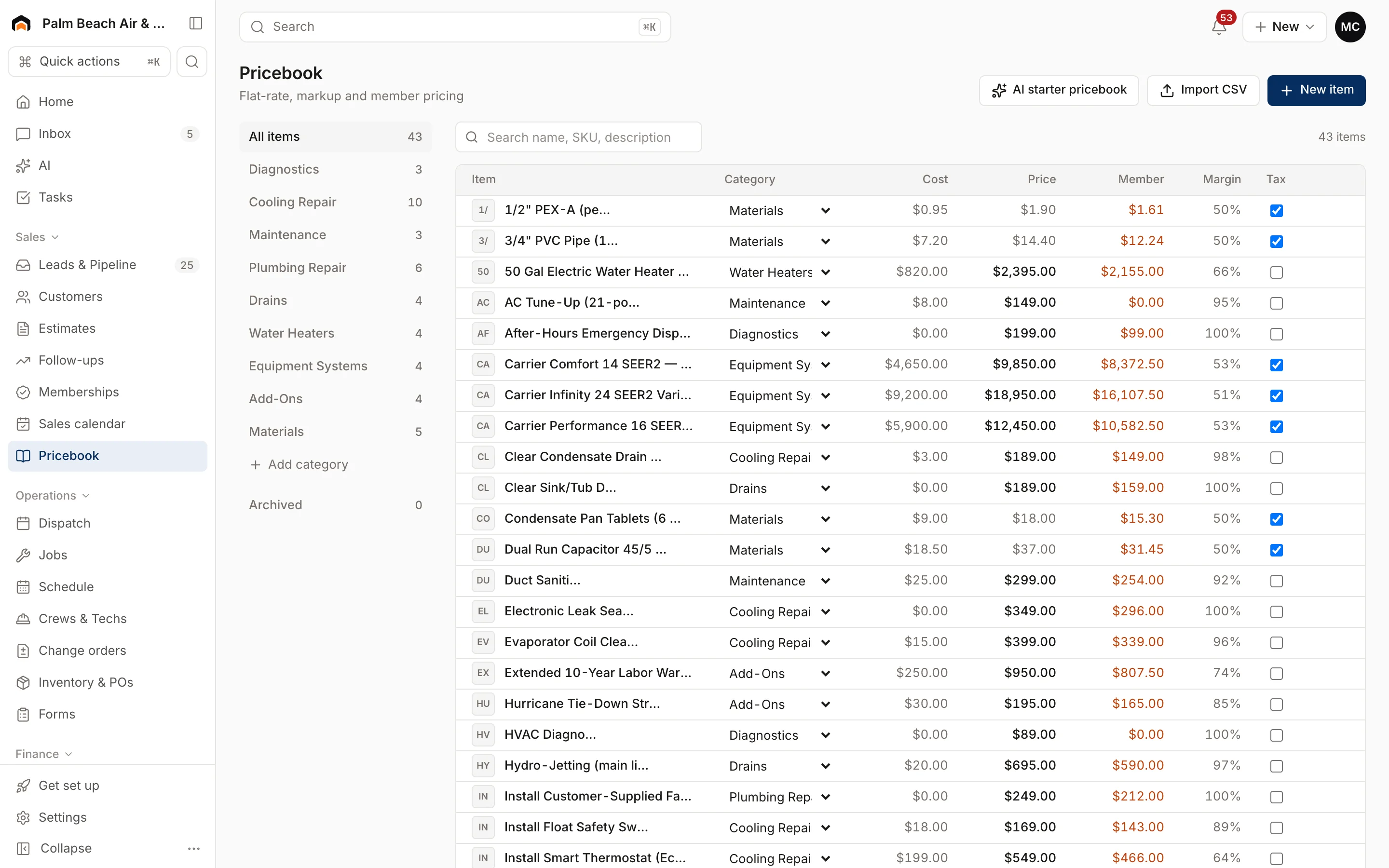
Homeforce's pricebook lets you store each task as a Service (flat rate) item with its own price, or price parts at cost plus a Markup %. If an item has no markup of its own, the default markup for its type is used. Costs and margins are hidden from techs, so they see the price but not your cost. See Set up your pricebook.
On estimates, you can lay out good, better and best options, mark the one you recommend, and require a deposit when the customer approves (Build estimate options and pricing). For T&M work, add a Custom line on the invoice for the hours worked and pull materials from the pricebook.
FAQ
Is flat rate or time and materials more profitable?
Neither is automatically more profitable. Flat rate tends to reward efficiency, because a faster tech doesn't shrink the bill, but only if your task times and billable rate are built from real numbers. T&M protects you on unpredictable work but caps what you can earn on routine work.
Can I charge flat rate for some jobs and T&M for others?
Yes, and most service businesses do. A common setup is flat rate for repeatable service and replacement tasks, a diagnostic fee for troubleshooting, and T&M or change orders for remodel work and hidden conditions. Just tell the customer in writing which one applies before you start.
How do I explain a flat-rate price that seems high for a short job?
Price and describe the outcome, the warranty and what's included, not the minutes. Remind the customer that the price is the same even if the job runs long, so they're protected from surprises. Offering a lower-priced option alongside it also helps.
What should a time-and-materials estimate include?
It should include the hourly rate, any trip charge or minimum, how materials are marked up, an estimated range of hours, and a not-to-exceed amount where you'll stop and get approval. Get it signed or approved before work starts. The invoice should list hours and materials line by line.
Sources
- FAR 16.601 Time-and-materials contracts, Acquisition.gov (U.S. General Services Administration). Accessed 2026-11-03.
- Rebuilding After the 2025 LA Wildfires: Important Contract & Payment Rules, California Contractors State License Board. Accessed 2026-11-03.
- Plumbers, Pipefitters, and Steamfitters: Occupational Outlook Handbook, U.S. Bureau of Labor Statistics. Accessed 2026-11-03.
- The Positive Aspects of Flat Rate Pricing, ACHR News. Accessed 2026-11-03.