
Pricing
How to price HVAC jobs so every call makes money
How to price HVAC jobs step by step: loaded labor cost, overhead per billable hour, markup vs margin, parts markup, and worked repair and replacement prices.
The Homeforce team · · 8 min read
To price HVAC jobs profitably, work out what one billable hour really costs your company (the tech's wage, taxes and benefits, plus your share of overhead), divide by one minus your target profit margin to get an hourly selling rate, then price each task as book hours times that rate plus marked-up parts. Install the same price in a pricebook so every tech quotes the same number for the same job.
That's the whole method. The rest of this guide walks through each step with real numbers, explains the markup-versus-margin trap that catches a lot of shops, and finishes with a fully worked repair price and a fully worked system replacement price you can copy into a spreadsheet.
What does an HVAC technician actually cost per hour?
Start with wages. According to the U.S. Bureau of Labor Statistics, the median pay for heating, air conditioning and refrigeration mechanics and installers was $29.33 an hour ($61,010 a year) in May 2025. Your local rate may be well above or below that, so use your own payroll numbers.
The wage is only part of the cost. Payroll taxes, workers' comp, health insurance, paid time off and retirement contributions all sit on top. For context, BLS Employer Costs for Employee Compensation data for June 2026 shows private-industry benefits averaging $14.07 an hour against $32.82 in wages, or 30% of total compensation. That works out to roughly 43 cents of benefits for every dollar of wages across private industry. Your burden will differ, but it is rarely small.
Loaded labor cost per billable hour
Here's the step most shops skip: you pay for every hour on the clock, but you can only charge for the hours a tech spends on customer jobs. Shop time, training, callbacks, waiting on parts and the drive back at the end of the day all get paid and none get billed.
Example (illustrative numbers):
- Wage: $29.33/hr
- Burden (taxes, comp, benefits): say 40%, so $29.33 × 1.40 = $41.06 per paid hour
- Paid hours per year: 40 × 52 = 2,080
- Annual loaded cost: $41.06 × 2,080 = $85,405
- Billable hours per year: say 1,250 (about 60% of paid hours)
- Loaded labor cost per billable hour: $85,405 ÷ 1,250 = $68.32
If you'd priced off the $29.33 wage, you'd be less than half way to your real labor cost. Track billable hours for a month or two to get your own ratio instead of guessing.
How do you recover overhead in your price?
Overhead is everything that isn't tied to one job: trucks and fuel, insurance, office staff, rent, software, phones, marketing, tools, and the owner's salary if you're not billing hours yourself. Add it up for the last 12 months (or budget it for the next 12), then spread it across every billable hour your field team produces.
Example (illustrative):
- Annual overhead: $480,000
- Five service techs × 1,250 billable hours = 6,250 billable hours
- Overhead per billable hour: $480,000 ÷ 6,250 = $76.80
Now your break-even cost per billable hour is labor plus overhead:
$68.32 + $76.80 = $145.12
Every hour you sell below $145.12 loses money before you've earned a cent of profit. That number is worth writing on the office whiteboard.
Markup vs margin: what's the difference?
Markup is profit as a percentage of cost. Margin is profit as a percentage of selling price. They describe the same dollars from two directions, and confusing them is the most common pricing mistake in the trades.
Say a job costs you $100 and you add 20%: you charge $120. Your markup is 20%, but your margin is only $20 ÷ $120 = 16.7%. If your goal was a 20% margin, you came up short.
The conversion arithmetic:
- Margin = markup ÷ (1 + markup)
- Markup = margin ÷ (1 − margin)
- Price for a target margin = cost ÷ (1 − margin)
| Markup on cost | Margin on price |
|---|---|
| 25% | 20% (0.25 ÷ 1.25) |
| 43% | 30% (0.43 ÷ 1.43) |
| 50% | 33.3% (0.50 ÷ 1.50) |
| 67% | 40% (0.67 ÷ 1.67) |
| 100% | 50% (1.00 ÷ 2.00) |
Set your goal as a margin (that's how your P&L reads), then use the divide-by-one-minus formula to get the price.
Your hourly selling rate
Using the $145.12 break-even hour and a target 20% net profit margin:
$145.12 ÷ (1 − 0.20) = $145.12 ÷ 0.80 = $181.40 per billable hour
Pick your own target. The point is that profit is built on top of a full cost, not on top of a wage.
How much should you mark up HVAC parts and materials?
Materials need a markup too. Someone had to order the part, pick it up or stock it, carry it on a truck, and warranty it if it fails. The same margin formula applies:
- Capacitor cost: $45
- Target margin on parts: 50%
- Price: $45 ÷ (1 − 0.50) = $90 (a 100% markup)
You can also use a sliding scale instead of one percentage: a higher markup on cheap parts (where the handling cost is a big share of the part's value) and a lower one on expensive equipment (where a high percentage would make the price uncompetitive). Whatever you choose, write it down and put it in your pricebook so it's applied the same way every time.
How does flat-rate task pricing work?
Flat-rate (sometimes called upfront) pricing gives the customer one price for a defined task before work starts, instead of billing hours and parts after. You build each flat rate from the same inputs:
Flat rate = (book hours × hourly selling rate) + parts price
"Book hours" is the average time the task takes your techs, including setup and cleanup. Get it from your own job history, and update it when you find a task consistently runs long. If your techs are faster than book, you keep the efficiency; if a job runs over, you absorb it. That's the trade-off. For a deeper look at when each model makes sense, see Flat rate vs time and materials.
Worked example 1: pricing an HVAC repair
A customer has no cooling. Your tech diagnoses a failed dual run capacitor. Using the illustrative numbers above:
Your cost
- Labor and overhead: 0.75 book hours × $145.12 = $108.84
- Part: $45.00
- Total cost: $153.84
Your price
- Labor: 0.75 × $181.40 = $136.05
- Part: $45 ÷ 0.50 = $90.00
- Subtotal: $226.05, rounded to $229
Check the result
- Gross profit: $229 − $153.84 = $75.16
- Margin: $75.16 ÷ $229 = 32.8%
The blended margin lands above the 20% labor target because the part carries a higher margin. That's normal on small repairs, and it's what pays for the slow days. If you also charge a diagnostic or trip fee, build it the same way: average diagnostic time × hourly rate.
Worked example 2: pricing a system replacement
A customer needs a new 3-ton split air conditioner and matching coil. Before quoting equipment size, confirm it. Our HVAC tonnage calculator gives a quick ballpark, but the proper method is a room-by-room load calculation using ACCA Manual J, the ANSI-recognized standard for residential HVAC sizing loads, which ACCA notes is required by national building codes and most state and local jurisdictions.
Your cost (illustrative)
- Condenser and coil: $4,200
- Install materials (line set, pad, disconnect, whip, refrigerant, fittings): $650
- Permit: $150
- Labor and overhead: 2 installers × 10 hours = 20 hours × $145.12 = $2,902.40
- Total cost: $7,902.40
Your price
Price each bucket at its own target:
- Labor: 20 hours × $181.40 = $3,628.00
- Equipment and materials at a 35% margin: $4,850 ÷ (1 − 0.35) = $4,850 ÷ 0.65 = $7,461.54
- Permit passed through at cost: $150.00
- Subtotal: $11,239.54, rounded to $11,250
Check the result
- Gross profit: $11,250 − $7,902.40 = $3,347.60
- Margin: $3,347.60 ÷ $11,250 = 29.8%
Consider adding a small line for warranty callbacks too, since a replacement can bring a return visit in its first year. Build it in as a cost rather than hoping it doesn't happen.
On a job this size, offer options. Quote the same scope with a standard, mid-efficiency and high-efficiency system so the customer chooses between your prices rather than between you and another contractor. And ask for a deposit before ordering equipment; see How much deposit should a contractor ask for.
How often should you update HVAC prices?
Revisit the inputs whenever they move: a wage increase, a new truck payment, an insurance renewal or a supplier price change. A full review once a year is a reasonable minimum, plus a quick parts-cost check whenever your supplier sends a new price sheet. Recalculate the break-even hour first, then let the hourly rate and flat rates follow from it.
Doing this in Homeforce
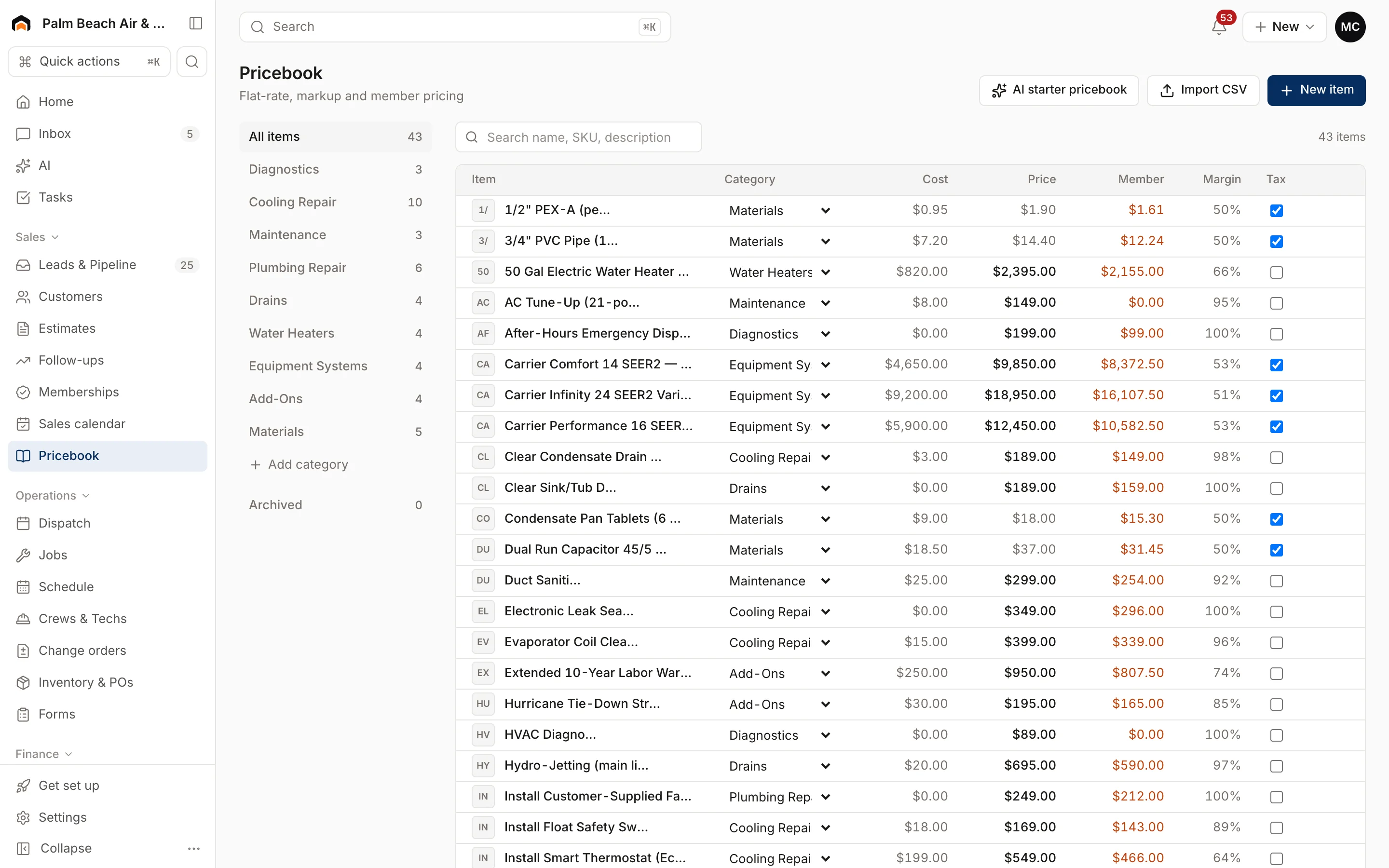
Homeforce's pricebook stores each service, material and equipment item with its Cost, Markup %, Flat-rate price and Member price. If an item has no flat price, Homeforce prices it at cost plus markup, using the default markup for that item type from Settings → Pricebook when the item has none of its own. Costs and margins are visible only to owners, admins, project managers and accounting, so techs see prices but not your margins. See Set up your pricebook.
On estimates, new quotes start with Good, Better and Best options, and you can set a Deposit % that's collected when the customer approves. See Build estimate options and pricing.
FAQ
What is a good profit margin for an HVAC business?
It depends on your market, mix of service versus installation work, and how lean your overhead is. Rather than copying a number, set a target net margin, then work backwards with price = cost ÷ (1 − margin). Check your actual results against the target every month.
Should I charge by the hour or flat rate for HVAC repairs?
Flat rate gives the customer a firm price before work starts and rewards efficient techs, while hourly billing protects you on unpredictable jobs. A practical split is flat rate for common repairs and time and materials for open-ended troubleshooting. Either way, build both from the same break-even hour.
How do I calculate my HVAC labor rate?
Add the tech's wage and burden (taxes, insurance, benefits) to get the loaded cost per paid hour, then convert to cost per billable hour by dividing annual cost by billable hours. Add overhead per billable hour to get your break-even rate. Divide that by one minus your target margin to get your selling rate.
How do I size an air conditioner before quoting a replacement?
A quick estimate from square footage is fine for a first conversation, and our HVAC tonnage calculator can help. For the actual quote, run an ACCA Manual J load calculation, which is the recognized standard for residential sizing and is required by building codes in most jurisdictions.
Sources
- Heating, Air Conditioning, and Refrigeration Mechanics and Installers: Occupational Outlook Handbook, U.S. Bureau of Labor Statistics. Accessed 2026-11-03.
- Employer Costs for Employee Compensation news release, U.S. Bureau of Labor Statistics. Accessed 2026-11-03.
- Manual J: Residential Load Calculation, Air Conditioning Contractors of America (ACCA). Accessed 2026-11-03.