
Estimating
How to write a painting estimate (with a worked room example)
How to write a painting estimate: measure walls, figure gallons and labor hours, add overhead and profit, and write the scope, exclusions and terms.
The Homeforce team · · 9 min read
Writing a painting estimate comes down to two jobs: working out a price, then putting it in writing. For the price, measure every surface, figure the gallons from the paint's coverage rate, estimate labor hours from your production rates, then add overhead and profit. For the written estimate, spell out the scope, the prep, the exact products, what's excluded, and how you get paid, so the customer knows what they're buying and you know what you promised.
Below are the steps in order, with a full interior bedroom example worked from tape measure to final price. To do the gallon math faster, use the paint calculator. For a blank layout to fill in, grab one of our estimate templates.
Step 1: Do the walkthrough and measure
Walk the job with the customer and write down everything that affects time: furniture to move, nail holes and cracks, peeling or glossy surfaces, stains that need a stain-blocking primer, high ceilings, and color changes. Ask when the house was built. That answer decides whether lead rules apply (more below).
Then measure each room.
How do you calculate wall area for painting?
Wall area = room perimeter × wall height − doors and windows
- Perimeter = (length + width) × 2
- Use real opening sizes if you can. Otherwise, say a standard door is 3 × 7 ft (21 sq ft) and a typical window is 3 × 5 ft (15 sq ft). Those are working assumptions, so measure anything unusual.
- Ceiling area = length × width.
- Trim gets counted, not measured by area: linear feet of baseboard and crown, plus the number of doors, frames and window casings.
Step 2: Figure paint quantities from the coverage rate
Use the coverage (spread rate) from the manufacturer for the product you're quoting. For example, Benjamin Moore lists Regal Select Matte at 400 to 450 sq ft per gallon, with 1 or 2 coats recommended. Rough, porous or patched surfaces take more paint than the label suggests, so price from the low end of the range.
Gallons = area × coats ÷ coverage per gallon, rounded up to whole gallons (or quarts for small trim quantities).
How many coats should you price?
That's your call, and the estimate should say it in writing. We use two coats in the example below because it includes a color change. The manufacturer's "1 or 2 coats" leaves room for either. Whatever you choose, put the number of coats on the estimate so a lower bid that quietly assumes one coat is easy for the customer to spot.
Step 3: Estimate labor with your production rates
Labor is usually the biggest cost on a paint job. You estimate it from production rates, meaning how much your crew actually gets done per hour. The best rates are your own, taken from past job hours. If you haven't tracked them yet, start with conservative assumptions and adjust as your job costing builds up.
The rates in the example below are illustrative assumptions, not industry standards:
- Walls, roll and cut: 175 sq ft per hour per coat
- Ceilings, roll and cut: 150 sq ft per hour per coat
- Prep (moving furniture, masking, patching, caulking) and cleanup as separate line-item hours
Keep prep separate. It varies the most from job to job, and it's where underbids usually come from.
Step 4: Add materials, overhead and profit
Price = (labor + materials + overhead) ÷ (1 − target margin)
- Labor: hours × your loaded labor cost (wage plus payroll taxes, workers' comp and benefits), not the bare hourly wage.
- Materials: paint, primer and sundries such as tape, plastic, caulk, patch, roller covers and sandpaper.
- Overhead: the costs of running the business (vehicle, insurance, office, marketing, software), spread across your billable hours.
- Profit: divide by (1 − margin). Multiplying by 1 + markup gives you less: a 30% markup is only a 23% margin.
Worked example: a 12 × 14 bedroom
Every input below is an illustrative assumption. Use your own costs.
Measurements
- Room: 12 × 14 ft, 8 ft ceilings
- Perimeter: (12 + 14) × 2 = 52 ft
- Gross wall area: 52 × 8 = 416 sq ft
- Deduct 1 door (21 sq ft) and 2 windows (2 × 15 = 30 sq ft): 416 − 51 = 365 sq ft of walls
- Ceiling: 12 × 14 = 168 sq ft
- Trim: about 49 lf of baseboard (52 lf minus the 3 ft door opening), 1 door and frame, 2 window casings
Paint (two coats, using the low end of 400 sq ft/gal)
- Walls: 365 × 2 ÷ 400 = 1.8, so 2 gallons
- Ceiling: 168 × 2 ÷ 400 = 0.8, so 1 gallon
- Trim: 1 quart of semi-gloss
Labor hours
- Prep (move and cover furniture, mask, patch, caulk): 2.5 h
- Ceiling: 336 sq ft (two coats) ÷ 150 = 2.25 h
- Walls: 730 sq ft (two coats) ÷ 175 = 4.2, so 4.25 h
- Trim, door and casings: 2.5 h
- Cleanup and walkthrough: 1 h
- Total: 12.5 hours
Costs
- Labor: 12.5 h × $35 loaded = $437.50
- Materials: wall paint 2 × $60 = $120, ceiling paint $45, trim quart $25, sundries $40 = $230
- Overhead: 12.5 h × $25 per labor-hour = $312.50
- Total cost: $980
Price at a 30% margin: $980 ÷ 0.70 = $1,400
Check: $1,400 − $980 = $420 gross profit, and $420 ÷ $1,400 = 30%.
Offer good, better and best options
Options let the customer choose a scope and budget instead of saying yes or no to a single number. Build each option from the same takeoff:
- Good: walls only, two coats. Prep 2 h + walls 4.25 h + cleanup 0.75 h = 7 h × $35 = $245 labor. Materials are $120 of paint plus $30 of sundries = $150. Overhead is 7 × $25 = $175. Cost $570, divided by 0.70 = $815.
- Better: walls, ceiling and trim. The worked example above: $1,400.
- Best: Better, plus a premium wall paint and extra prep. Add $30 a gallon on 2 gallons (+$60) and 1.5 h of extra patching and sanding (+$52.50 labor, +$37.50 overhead). Cost $1,130, divided by 0.70 = $1,615.
Each option should list exactly what's included, so customers compare scope, not just price.
What to put in the written estimate
A good written estimate prevents most scope arguments before they start. Include:
- Customer, job address and date, plus how long the price is good for.
- Scope by room and surface: "Primary bedroom: walls, ceiling, baseboards, 1 door and frame, 2 window casings."
- Prep: what you'll do (patch nail holes, caulk trim gaps, spot-prime stains, mask and cover floors) and what's extra (drywall repair beyond a set size, wallpaper removal).
- Products: brand, product line, sheen and number of coats for each surface. Colors can follow, but note who supplies them and when they're due.
- Exclusions: say plainly what you're not doing, such as closets, furniture moving beyond light items, or hidden damage found during prep.
- Change orders: extra work gets priced and approved in writing before you do it.
- Payment terms: deposit amount, when the balance is due, and how they can pay. Our guide to how much deposit a contractor should ask for covers this.
- Lead-safe statement for homes built before 1978 (next section).
- Signature and acceptance.
If you're weighing a fixed price against hourly billing for repaint work, see flat rate vs. time and materials.
Lead-safe rules for pre-1978 homes (EPA RRP)
If the home was built before 1978, the EPA's Renovation, Repair and Painting (RRP) rule likely applies. Under the RRP rule, firms paid to disturb paint in pre-1978 housing, child care facilities and preschools must be EPA- or state-certified. The work must be done by certified renovators, or by workers trained on the job by one, using lead-safe work practices (EPA). That includes sole proprietors.
Minor repair and maintenance that disturbs 6 sq ft or less of paint per room inside, or 20 sq ft or less outside, isn't covered. Window replacement and demolition of painted surfaces are covered at any size (EPA). Before work starts, you must give the owner, and any adult occupant of a rental unit, the EPA's Renovate Right pamphlet. You then get a written acknowledgment, or a certificate of mailing at least seven days before the work (EPA FAQ). Some states run their own authorized programs (EPA), so check yours.
For your estimate, this means:
- Price the extra time and materials lead-safe practices require (containment, cleanup, verification).
- Add a line for pamphlet delivery and record-keeping.
- Ask about the build year at the walkthrough, every time.
Doing this in Homeforce
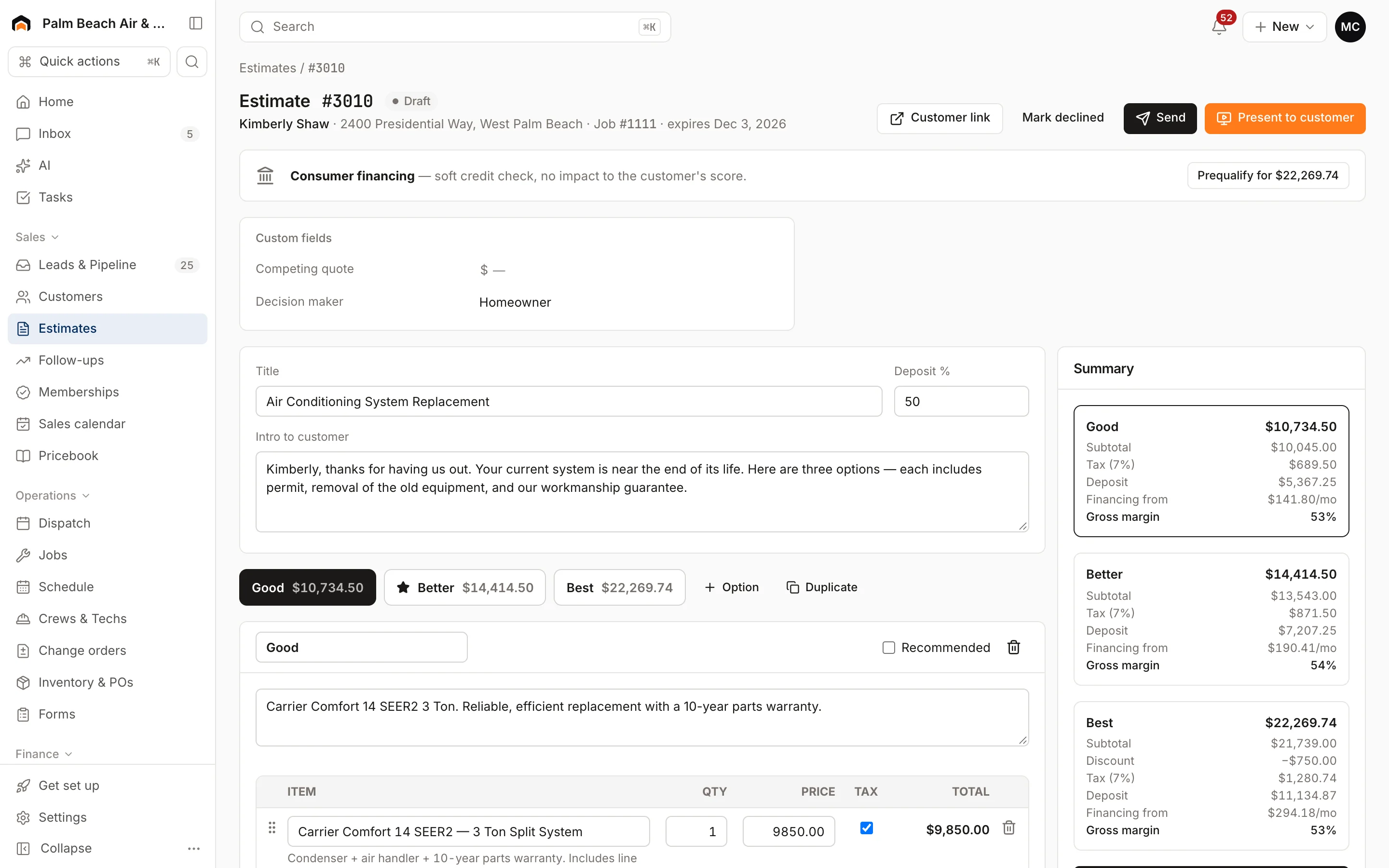
In Homeforce, you build estimates from your pricebook, so the whole crew quotes the same prices. Pricebook items can carry a cost, a markup or flat-rate price, and a Unit such as sq ft. New estimates start with Good, Better and Best options, with Better marked as recommended. You can also set a Deposit % that the customer pays when they approve. People who can see costs see the gross margin for each option as they build it. Your terms go at the bottom of the proposal, so scope, exclusions and payment terms ship with every estimate.
After the job is paid in full, Homeforce can automatically send a review request with your review link. See how to get more Google reviews.
FAQ
How do I calculate how much paint I need for a room?
Multiply the room's perimeter by the wall height, subtract doors and windows, then multiply by the number of coats. Divide by the paint's coverage per gallon from the manufacturer, and round up. For example, 365 sq ft of walls × 2 coats ÷ 400 sq ft/gal is 1.8, so you'd buy 2 gallons.
How much should I charge to paint a room?
Price it from your own costs: labor hours × loaded labor rate, plus materials, plus overhead, divided by (1 − your target margin). In our worked example, a 12 × 14 bedroom with walls, ceiling and trim came to $1,400 at a 30% margin. Your number will change with your wages, overhead and production rates.
What should a painting estimate include?
List the scope by room and surface, the prep work, the exact products and number of coats, and what's excluded. Add how change orders work, your deposit and payment terms, and a lead-safe statement for pre-1978 homes. Finish with how long the price is valid and a place to sign.
Do painters need lead certification for older homes?
If you're paid to disturb paint in a home, child care facility or preschool built before 1978, the EPA's RRP rule generally requires your firm to be certified. The work must be done by certified renovators, or by workers trained by one, using lead-safe practices. Small jobs under 6 sq ft per room inside or 20 sq ft outside are exempt, but window replacement and demolition never are.
Should I offer good, better and best options on painting estimates?
Usually, yes. Options let customers pick a scope and budget instead of just accepting or rejecting one number. Build all three from the same measurements and list exactly what each one includes.
Sources
- Regal Select Waterborne Interior Paint, Matte, Benjamin Moore. Accessed 2026-11-03.
- Renovation, Repair and Painting Program: Contractors, U.S. Environmental Protection Agency. Accessed 2026-11-03.
- Lead Renovation, Repair and Painting Program Rules, U.S. Environmental Protection Agency. Accessed 2026-11-03.
- Renovation, Repair and Painting Program, U.S. Environmental Protection Agency. Accessed 2026-11-03.
- Frequent questions about pre-renovation education under the RRP rule, U.S. Environmental Protection Agency. Accessed 2026-11-03.