
Getting paid
How much deposit should a contractor ask for? State caps, schedules and how to collect
How much deposit should a contractor ask for? State deposit caps (CA, MD, MA), progress payment schedules, a worked $18,000 example, and how to collect.
The Homeforce team · · 9 min read
There's no single national number, so the honest answer starts with your state. Some states cap home-improvement deposits by law. California limits them to $1,000 or 10% of the contract price, whichever is less. Maryland caps them at one-third of the contract price. Massachusetts caps them at one-third or the cost of special-order materials, whichever is greater. If your state has a cap, that's your ceiling.
Where there's no cap, a sensible deposit covers your real exposure: the special-order materials you can't return, plus enough to hold a spot on your schedule. It shouldn't be so large that the customer is paying for work you haven't done. On bigger jobs, collect the rest in progress payments tied to visible milestones. This guide covers the state rules we could verify, a worked $18,000 roofing example in a capped and an uncapped state, and how to actually collect and credit the money.
Why ask for a deposit at all?
A deposit does three jobs:
- It covers materials you have to commit to. Special-order windows, cabinets, custom-color siding and roofing shingles in a particular color are hard or impossible to return.
- It holds a slot on your schedule. A customer who has paid something is far less likely to vanish or switch contractors the week before you start. (It also cuts no-shows on booked appointments; see how to reduce no-shows.)
- It confirms the customer is serious. A signed contract plus a payment is a much firmer yes than a verbal one.
What a deposit shouldn't do is fund your business ahead of the work. That's where state law steps in.
Which states limit how much deposit a contractor can take?
The rules below come straight from official state sources. Many other states have their own home-improvement laws, so treat this as a starting point, not a complete list.
| State | Deposit limit on home improvement work | Other payment rules worth knowing |
|---|---|---|
| California | The lesser of $1,000 or 10% of the total contract price | Every other payment must be listed in the contract and can't exceed the value of work completed or materials delivered to the home. The rules also cover residential solar and ADUs. |
| Maryland | No more than one-third of the contract price | No deposit or payment can be taken until both parties sign the contract. After the deposit, the payment schedule is up to you and the homeowner to negotiate. |
| Massachusetts | The greater of one-third of the contract price or the actual cost of special-order or custom materials that must be ordered in advance | The contract must state the payment schedule in dollars. Final payment can't be demanded until the work is complete to both parties' satisfaction. |
California's limit is the strictest of the three. On any job over $10,000, the cap is $1,000. On a $6,000 job, it's $600 (10% of $6,000).
The FTC's Cooling-Off Rule for sales made in the home
If you sell the job at the customer's home rather than at your office, a federal rule may also apply. Under the FTC's Cooling-Off Rule, buyers of covered sales of $25 or more made at their home get until midnight of the third business day to cancel for a full refund. You must tell them about this right and give them cancellation forms, and if they cancel you have 10 days to refund their money. The rule doesn't cover a visit the customer requested to repair or maintain their property, or bona fide emergencies, though extra items you sell beyond that request can be covered. The FTC's rule page has the full text (16 CFR Part 429). Some states have their own door-to-door rules too. Maryland's contractor guidance, for example, requires a separate notice of cancellation when the state's Door-to-Door Sales Act applies.
How much deposit is reasonable by job size?
Within your state's limits, size the deposit to your real exposure. Here's one practical way to think about it:
- Small service and repair calls. A deposit usually isn't worth the friction. Collect in full on completion, ideally on site.
- Mid-size jobs with stock materials. A modest deposit holds the date. In California, remember it's capped at 10% of the price (or $1,000).
- Jobs with special-order materials. Size the deposit to cover the non-returnable material cost, within any cap. Massachusetts's law explicitly allows a deposit equal to the cost of special-order materials when that's more than one-third.
- Large, multi-week projects. Keep the deposit moderate and use a progress payment schedule so payments track the work.
Homeowner advice points the same way. Connecticut's Department of Consumer Protection suggests three payments: a deposit plus initial materials, a payment about halfway through, and a final payment after completion. It also tells homeowners to treat a demand for full payment up front as a warning sign. If your schedule looks like that, customers recognize it as fair.
Worked example: deposit and progress payments on an $18,000 roof
Say you've sold an $18,000 asphalt shingle roof replacement. The milestone values below are illustrative, so use your own job numbers.
In a one-third-cap state (for example, Maryland)
The maximum deposit is $18,000 ÷ 3 = $6,000. You don't have to take the maximum. A schedule like this keeps the deposit under the cap and ties each payment to something the homeowner can see:
| Milestone | % | Amount |
|---|---|---|
| Deposit at contract signing (after signature) | 30% | $5,400 |
| Materials delivered and tear-off complete | 40% | $7,200 |
| Final walkthrough and cleanup complete | 30% | $5,400 |
| Total | 100% | $18,000 |
Check: $5,400 is less than the $6,000 cap, and $5,400 + $7,200 + $5,400 = $18,000.
In California
The deposit cap is the lesser of 10% × $18,000 = $1,800 and $1,000, so $1,000. Each later payment can't run ahead of the value of work done or materials delivered.
| Milestone | Amount | Assumed value delivered to date |
|---|---|---|
| Deposit at signing | $1,000 | n/a (capped deposit) |
| Materials delivered to the home | $6,000 | $7,000 in materials on site |
| Tear-off, deck repair and underlayment done | $6,000 | $13,500 of work and materials |
| Completion and final walkthrough | $5,000 | $18,000 |
| Total | $18,000 |
Check: $1,000 + $6,000 + $6,000 + $5,000 = $18,000. Running total paid ($1,000, then $7,000, then $13,000) stays at or below the assumed value delivered at each step ($7,000, then $13,500).
Crediting it on the final invoice
On the final invoice, show the full contract price, then subtract what has already been paid. In the California example, the final invoice reads: $18,000 contract, less $1,000 deposit applied, less $12,000 progress payments, for a balance due of $5,000. That makes it obvious the customer isn't paying twice.
What should the contract say about the deposit?
Put the payment terms in writing before you take any money. Maryland requires a signed contract before any payment, and it's good practice everywhere. At a minimum, cover:
- The deposit amount in dollars and when it's due.
- The payment schedule: each milestone and its dollar amount (Massachusetts requires amounts stated in dollars).
- What the deposit pays for, for example special-order materials.
- Cancellation and refunds: what's refundable, and how special-order materials already purchased are handled.
- Any cooling-off notice that applies to sales made in the home.
- How change orders affect later payments.
Starting from a template saves time. See our contract and estimate templates, and have your attorney adapt them to your state.
How do contractors collect deposits?
- Collect at signing, while the customer is ready. The easiest deposit to collect is the one requested right after the customer approves. Send a pay link or take the payment on the spot rather than waiting for a check.
- Take card or bank (ACH) payments. They're traceable for both sides. Connecticut's consumer agency tells homeowners to pay deposits by a traceable method like a credit card, and to avoid cash and peer-to-peer apps. Accepting cards makes you the easy choice.
- Send a receipt for every payment, showing what it was for and the remaining balance.
- Credit the deposit on the final invoice as its own line, so the customer sees it counted.
When do you have to refund a deposit?
Refund in full when a cooling-off cancellation applies or when your contract or state law requires it. If a job is canceled later, your written terms decide what's refundable, which is why they need to spell out special-order material costs. Refund through the original payment method, and keep a record of the reason.
Doing this in Homeforce
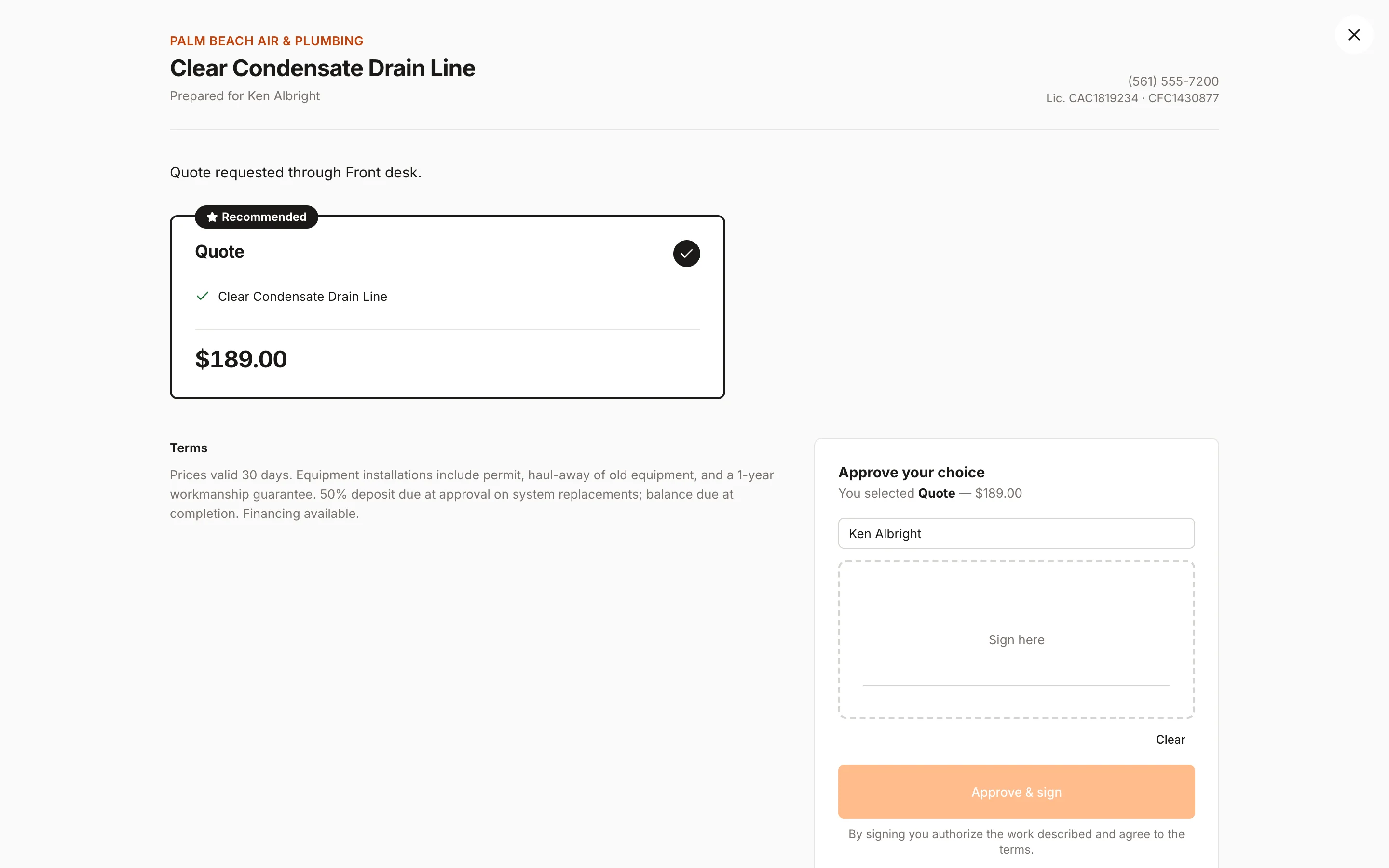
In Homeforce you set a Deposit % on each estimate, or set a default for all new estimates under Settings → Estimates & proposals. When the customer signs, Homeforce creates a deposit invoice for that percentage of the option they chose and shows them a Pay button right away, so they can pay by card or bank on the spot. Deposits aren't taxed. When you create the final invoice, the paid deposit appears as Deposit applied. See Collect a deposit.
Because the deposit is a percentage, in a capped state pick one that keeps the dollar amount under the limit. In California, 5% on an $18,000 job is $900.
For larger jobs, progress billing on projects (Scale plan) bills by percent complete, includes approved change orders, and credits the paid deposit on the next progress invoice (Bill a project in progress). If a job is canceled, refund the deposit from the deposit invoice (Refund a payment or void an invoice). Customers can pay deposits by card or bank through Homeforce payments.
FAQ
Is it legal for a contractor to ask for 50% up front?
It depends on your state and the type of work. In California, the deposit on home improvement work is capped at $1,000 or 10%, whichever is less, and in Maryland at one-third of the price, so 50% would be over the limit in both. In states without a cap it may be legal, but homeowner advice from state consumer agencies treats large upfront demands as a red flag.
What's the maximum deposit in California?
For home improvement contracts, the deposit can't be more than $1,000 or 10% of the contract price, whichever is less, according to the Contractors State License Board. Later payments must be listed in the contract and can't exceed the value of work completed or materials delivered. Check with CSLB for how this applies to your specific type of work.
Should the deposit be refundable?
Your contract should say exactly when it is and isn't. Deposits are generally fully refundable when a buyer cancels within a cooling-off period that applies to the sale. After that, a contract might make the deposit refundable minus the cost of special-order materials already purchased, but have an attorney check that against your state's law.
Do I charge sales tax on a deposit?
It depends on your state's tax rules, so ask your accountant. One approach is to calculate tax on the final invoice, where the full taxable amount is known, and treat the deposit as a credit toward that total.
Sources
- Rebuilding After the 2025 LA Wildfires: Important Contract & Payment Rules, California Contractors State License Board. Accessed 2026-11-03.
- Information for Contractors, Maryland Home Improvement Commission, Maryland Department of Labor. Accessed 2026-11-03.
- General Laws Chapter 142A, Section 2, Massachusetts Legislature. Accessed 2026-11-03.
- Buyer's Remorse: The FTC's Cooling-Off Rule May Help, Federal Trade Commission. Accessed 2026-11-03.
- Cooling-Off Period for Sales Made at Home or Certain Other Locations, Federal Trade Commission. Accessed 2026-11-03.
- How should I pay my contractor?, Connecticut Department of Consumer Protection. Accessed 2026-11-03.