
Seasonality
Running a landscaping business in winter: cash flow, services and spring pre-sales
How to run a landscaping business in winter: plan cash for the slow months, add off-season services, pre-sell spring work and keep your best crew coming back.
The Homeforce team · · 9 min read
In most of the country, a landscaping business in winter has three jobs: cover fixed costs while mowing revenue drops to zero, sell whatever off-season work fits your climate and equipment, and pre-sell spring so March starts with a full schedule instead of a quiet phone. The companies that come out of winter strongest plan the cash in October, not in January.
This guide walks through a cash reserve calculation with real arithmetic, the off-season services landscapers actually sell (snow, lights, dormant pruning, hardscape), how to pre-sell spring programs and mulch, equipment and crew planning, and what to market while the grass is asleep.
How do landscapers survive the winter financially?
Your revenue is seasonal. Most of your costs aren't. Truck and equipment payments, insurance, shop rent, phones, software and your office person keep billing all year. The fix is to know your winter gap in dollars and fund it on purpose during the busy months.
Worked example: how much cash do you need for December to February?
Here's an illustrative example. Every input is an assumption for a made-up company, so swap in your own numbers from last year's books.
Assumptions:
- Annual revenue: $480,000
- Share of revenue earned December through February (some snow and cleanup work): 8%
- Gross margin on winter work after labor, fuel and materials: 40%
- Fixed costs per winter month: $16,000 (equipment and truck notes $4,500, insurance $2,000, shop rent $2,500, office manager $3,500, owner's base pay $3,000, phones and software $500)
Step 1: winter revenue per month
$480,000 × 8% = $38,400 over three months $38,400 ÷ 3 = $12,800 a month
Step 2: what that revenue contributes toward fixed costs
$12,800 × 40% gross margin = $5,120 a month
Step 3: the monthly gap
$16,000 fixed − $5,120 contribution = $10,880 a month
Step 4: the three-month reserve, plus a cushion
$10,880 × 3 = $32,640 Add 25% for a late spring or a slow-paying commercial account: $32,640 × 1.25 = $40,800
Step 5: how much to set aside in season
Spread over nine in-season months: $40,800 ÷ 9 ≈ $4,530 a month
That last number is the useful one. Move about $4,530 into a separate reserve account every month from March through November and winter becomes a planned dip instead of a scramble. Don't forget March itself: you'll be buying mulch and paying a full crew for a few weeks before spring invoices are paid.
Smooth the curve with monthly billing
The other way to shrink the gap is to stop collecting all your money in season. Annual lawn programs billed monthly (fertilization, weed control, aeration, a spring and fall cleanup) keep cash coming in all twelve months. Using the same example, 80 customers on a program billed at $45 a month brings in $3,600 every winter month:
$10,880 gap − $3,600 = $7,280 a month $7,280 × 3 = $21,840 before the cushion, instead of $32,640
Be honest with yourself about what that is: it's timing, not extra profit. You still have to deliver those visits in season, so price the program on a full year of work. But it turns a three-month drought into a manageable gap.
What services can a landscaping business offer in winter?
Pick off-season work that uses equipment and skills you already have, and that your existing customers already trust you for. Selling to a customer list you already have is cheaper than finding new ones in January.
Snow and ice removal
Snow plowing and sidewalk clearing are the classic winter service, and the BLS notes that some grounds maintenance workers move to snow removal in winter. It's lucrative but different from mowing: you need plows or blades, salt storage, on-call crews at 3 a.m., and a clear contract. Decide up front whether you're pricing per push, per event or as a seasonal flat fee, and check that your insurance covers snow work before the first storm.
Holiday lighting installation and takedown
Holiday lights use ladders, crews and customer relationships you already have, and the work runs from early November through January takedown. Many companies sell it as a package: design, install, maintenance calls, removal and storage. It also gets you onto properties for a December conversation about spring.
Dormant pruning and tree work
Late winter is prime pruning time. University of Minnesota Extension recommends the late dormant season, late winter to early spring, for most trees and shrubs: wounds are exposed briefly before growth starts, and bare branches make structure easier to see. The same source says to avoid pruning oaks from April through October where oak wilt is a concern, which makes winter the natural window for oak work. Early spring bloomers like lilac and forsythia are an exception: the same source says to prune them right after they flower, since they bloom on last year's growth.
Hardscape and installs where the climate allows
In milder regions, or any stretch when the ground isn't frozen, winter is a good time for patios, walls, walkways, drainage fixes and lighting. Customers aren't competing with you for weekend time, and your crew stays on payroll. In colder markets, use winter to design, estimate and sign hardscape jobs so they start the moment the ground thaws.
Other add-ons
Depending on your market and equipment: leaf and gutter cleanup through December, firewood, storm cleanup, and indoor work like landscape design consultations. Don't add a service you can't do well. A bad winter job costs you the spring customer.
How do you pre-sell spring landscaping work?
The best use of a slow January is filling April. Customers who commit in winter don't shop around in spring.
- Renewal of annual programs. Send every current customer their program for next year in December or January, with this year's visits listed so they see what they got.
- Early-bid discounts. Offer a modest discount or a free add-on for programs signed and paid (or put on monthly billing) by a firm date, say February 28. A deadline does the selling.
- Mulch and spring cleanup packages. Quote mulch now so you can order material and schedule crews by route. Extension guidance generally recommends 2 to 3 inches of mulch, kept off the trunk; piling it into a "volcano" against trees causes problems. Measure beds and use our mulch calculator to turn square footage and depth into cubic yards.
- Good, better, best options. Quote spring work as tiers: cleanup only; cleanup and mulch; cleanup, mulch, edging and a first fertilizer application. Customers who would have said no to one price often pick the middle option.
What should landscapers do with equipment in the off-season?
Winter is when you fix what you limped through in August. Build a list from your crew leaders in November while the problems are fresh, then work through it:
- Service mowers, trimmers and blowers per the manufacturer's manual: oil, filters, plugs, belts, blade sharpening and balancing.
- Deal with fuel before storage the way your equipment maker recommends, so carburetors don't gum up.
- Inspect trailers, tires, lights and hitches, and fix the truck issues you've been ignoring.
- Decide what to replace. Winter is often a good time to buy, and you'll have last year's repair costs per machine to justify it.
Keep a simple log of what was done to each machine. When something fails in May, you'll know whether it was serviced.
How do you keep your landscaping crew over the winter?
Losing a trained crew leader every November means retraining every April. Your options, roughly from most to least retention:
- Keep core people on full time with snow, lights, pruning, hardscape, shop work and equipment maintenance. This is where off-season revenue pays for itself twice.
- Reduce hours for part of the crew and be upfront about when full hours return.
- Seasonal layoff with a firm rehire plan. Many landscape companies lay off for part of the winter. Unemployment insurance is run by each state, and each state sets its own eligibility rules, so point workers to your state's program rather than promising what they'll receive.
Whatever you choose, tell people early, give returning crew a start date and a reason to come back (a raise, a bonus for returning by a set date, a promotion to crew lead), and stay in touch over the winter. The BLS notes that some grounds jobs are seasonal and that hours run longest from spring through fall, so experienced workers know the pattern. The ones you want back will have other offers.
How do you market a landscaping business in winter?
Winter marketing is mostly about your existing list, plus groundwork for spring search traffic.
- Segment your customers and send targeted messages: mowing customers without a treatment program get the program offer, past mulch customers get the early-bid mulch offer, customers with large trees get the dormant pruning offer.
- Follow up on last season's open estimates. People who said "maybe next year" in September are next year's easiest sales.
- Ask for reviews from this season's customers if you didn't already. A stronger Google profile in March helps spring leads. See how to get more Google reviews.
- Update your website and photos with this year's best jobs, and make sure your service area and spring services are listed.
Doing this in Homeforce
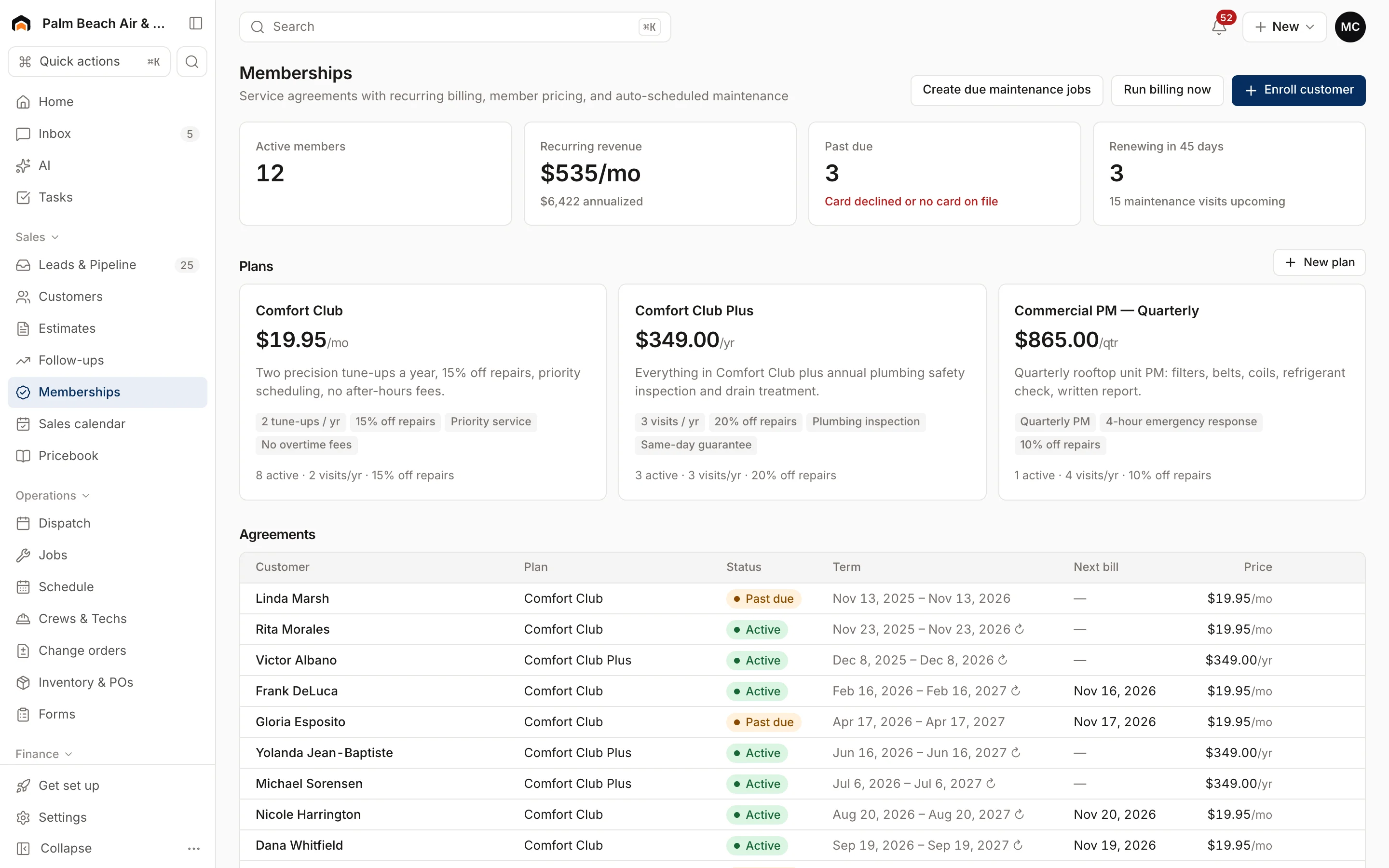
Memberships are how Homeforce handles recurring landscape programs. Create a plan with Monthly billing to smooth cash flow through winter, set the number of visits per year (up to 12), and Homeforce bills members on schedule and creates each visit as an unscheduled job about three weeks before it's due. That fits monthly or less frequent work like treatment programs and cleanups. Weekly or every-other-week mowing doesn't fit in a single plan today, so add those visits to a job yourself. See Recurring workflows by trade.
For winter marketing, the Marketing page (Pro and Scale plans) lets you build customer segments and send text or email campaigns to them. See Run campaigns and manage reviews. For spring pre-sales, estimates start with good, better and best options and can require a deposit on approval. See Build estimate options and pricing.
FAQ
What do landscapers do in the winter?
Many switch to snow and ice removal, holiday lighting, dormant pruning, and hardscape work where the ground allows. The rest of the time goes to equipment maintenance, planning, and pre-selling spring programs and mulch to existing customers.
How much money should a landscaping business save for winter?
Work out your monthly fixed costs, subtract what winter work contributes after its direct costs, multiply by the number of slow months and add a cushion. In our example that came to about $40,800, or roughly $4,530 set aside each in-season month. Your number depends on your own costs and climate.
Is winter a good time to prune trees and shrubs?
For most trees and shrubs, yes. University of Minnesota Extension recommends the late dormant season, late winter to early spring. Early spring bloomers like lilac and forsythia are an exception and should be pruned right after flowering.
How can a lawn care business make money in the off-season?
Sell annual programs billed monthly so cash arrives year-round, add winter services that fit your equipment, and pre-sell spring cleanups and mulch with an early-bid deadline. Monthly billing shifts when you collect, so price the program on the full year of work.
Sources
- Grounds Maintenance Workers: Occupational Outlook Handbook, U.S. Bureau of Labor Statistics. Accessed 2026-11-03.
- Pruning trees and shrubs, University of Minnesota Extension. Accessed 2026-11-03.
- Too much of a good thing, mulch volcanoes slowly kill trees, University of Illinois Extension. Accessed 2026-11-03.
- How Do I File for Unemployment Insurance?, U.S. Department of Labor. Accessed 2026-11-03.