
Memberships
HVAC maintenance agreement pricing: how to set a plan price that pays
HVAC maintenance agreement pricing from the ground up: cost a tune-up visit, add the member discount, hit a target margin and set monthly vs annual prices.
The Homeforce team · · 7 min read
To price an HVAC maintenance agreement, add up what the plan costs you to deliver for a year (the included tune-up visits, the repair discount you give members, and payment processing), then divide by one minus your target margin. That gives you the annual price; divide by 12 for a monthly option. Then check the result against what customers in your area will pay and adjust the plan's contents, not just the price.
This guide covers what a tune-up should include, how to cost one visit, a full worked plan price with the arithmetic shown, which perks to offer, how to keep members renewing, and how to add a plumbing option.
What's included in an HVAC maintenance agreement?
Most residential plans bundle three things: scheduled tune-up visits, a discount on repairs, and a few perks such as priority scheduling. The tune-up is the core of the plan, so define it in writing before you price anything.
What does an HVAC tune-up include?
ENERGY STAR's maintenance checklist recommends a contractor check-up every year, with cooling checked in spring and heating in fall. Its list of what a visit covers includes:
- General: checking thermostat settings, tightening electrical connections, measuring motor voltage and current, lubricating moving parts, checking the condensate drain, and checking controls and the startup cycle.
- Cooling: cleaning evaporator and condenser coils, checking refrigerant level, and cleaning and adjusting blower components for proper airflow.
- Heating: checking gas or oil connections, gas pressure, burner combustion and the heat exchanger.
ENERGY STAR also tells homeowners to check, clean or change their air filter monthly, so a plan that includes a filter (or a reminder to change it) maps neatly to that advice.
Two visits a year (spring cooling, fall heating) is the natural fit for a system with both an air conditioner or heat pump and a furnace. A cooling-only or heating-only customer may only need one.
How much does a maintenance visit cost you?
Price the plan from your cost, not from a competitor's flyer. Start with your break-even cost per billable hour (wage, burden and overhead per billable hour; How to price HVAC jobs walks through that calculation). Then time a real tune-up, including the drive.
Example (illustrative numbers):
- Visit time including drive: 1.0 hour
- Break-even cost per billable hour for a maintenance tech: $85
- Consumables (coil cleaner, lubricant, a few fittings): $8
- Cost per visit: $85 + $8 = $93
- Two visits a year: $186
If a maintenance tech has a lower loaded wage than your senior repair techs, routing tune-ups to them lowers this number. If the visit includes a filter, add its cost.
How do you set the price of a maintenance plan?
Now add the other costs of membership and apply your margin.
Step 1: Cost of the member discount
The repair discount is a real cost: it's revenue you give up on work you would have sold anyway. Estimate it from your own data.
- Average repair spend per member per year: say $300
- Member discount: say 15%
- Discount cost: $300 × 0.15 = $45 per member per year
If you don't have history yet, start with a conservative guess and revisit after the first season.
Step 2: Payment processing
If you bill by card, the processor takes a percentage of every charge. Use your own rate; for this example, say 3% of the plan price.
Step 3: Solve for the price
Annual cost before processing: $186 (visits) + $45 (discount) = $231
Target margin: say 25%. Because processing is a percentage of the price, subtract it alongside the margin:
Price = $231 ÷ (1 − 0.25 − 0.03) = $231 ÷ 0.72 = $320.83 a year
Step 4: Monthly vs annual pricing
- Monthly: $320.83 ÷ 12 = $26.74, rounded to $27 a month ($324 a year)
- Annual: you might offer a lower prepaid price, say $299 a year, because you get the cash up front and don't risk a card failing mid-year.
Check the annual option's margin:
- Processing: $299 × 0.03 = $8.97
- Profit: $299 − $231 − $8.97 = $59.03
- Margin: $59.03 ÷ $299 = 19.7%
That's lower than your 25% target, so decide whether the up-front cash is worth roughly five points of margin. If not, set the annual price closer to $320.
What if the price comes out too high for your market?
Don't just cut the price and eat the loss. Pull a lever you control:
- Tighten the visit scope and time (but don't skip checklist items).
- Route tune-ups to a maintenance tech with a lower loaded cost.
- Lower the repair discount, or set a smaller member price on big-ticket parts.
- Offer one visit instead of two for single-system customers.
You may decide to price a plan near cost on purpose, treating it as a way to stay in front of customers for future repairs and replacements. That can be a reasonable choice, but make it a decision you can see in the numbers, not an accident.
What perks should a maintenance agreement include?
Good perks cost you little and are easy to explain on a doorstep:
- Priority scheduling during heat waves and cold snaps
- Waived trip or diagnostic fee on repair calls (cost it like the discount: average diagnostic fee × expected calls per member)
- Repair discount (already priced in above)
- Filter included at each visit (add the filter's cost to the visit)
- No overtime charge for after-hours calls
Every perk that costs money should appear in your cost build-up. Every perk that doesn't, like priority booking, is free value.
How do you keep members renewing?
A plan is only worth the margin above if members stay. A few habits make the difference:
- Get a card on file at enrollment. Monthly charges then happen without the customer having to act, and failed cards show up early.
- Actually deliver the visits. Book tune-ups before the season rush and send reminders so customers are home; see How to reduce no-shows.
- Show the value. Leave a short visit report and point out what the discount saved them on any repair.
- Work the renewal list. Call members whose agreement ends in the next month or so, especially anyone who has turned off auto-renew.
- Chase failed payments fast. A member with a declined card is at risk of lapsing.
Can you add plumbing to an HVAC maintenance plan?
Yes, and it fits naturally for shops that do both trades. A simple add-on is an annual water heater flush plus a whole-home plumbing check. Rheem recommends flushing a tank water heater once a year for most households and every six months where water is hard, so one or two visits a year matches the manufacturer guidance.
Price it the same way: visit time × break-even rate + consumables, plus any discount cost, divided by one minus your margin. You can sell it as a separate plumbing plan or a higher tier that combines HVAC and plumbing visits.
Doing this in Homeforce
In Homeforce, memberships are set up as plans with a Price, Billing frequency (Monthly, Quarterly or Annual), Visits per year (0 to 12), a Repair discount % and a list of Perks. Every plan runs on a 12-month term. Plans can't be edited or retired after they're created, so finalize your numbers with the math above before you click Create plan. See Set up membership plans.
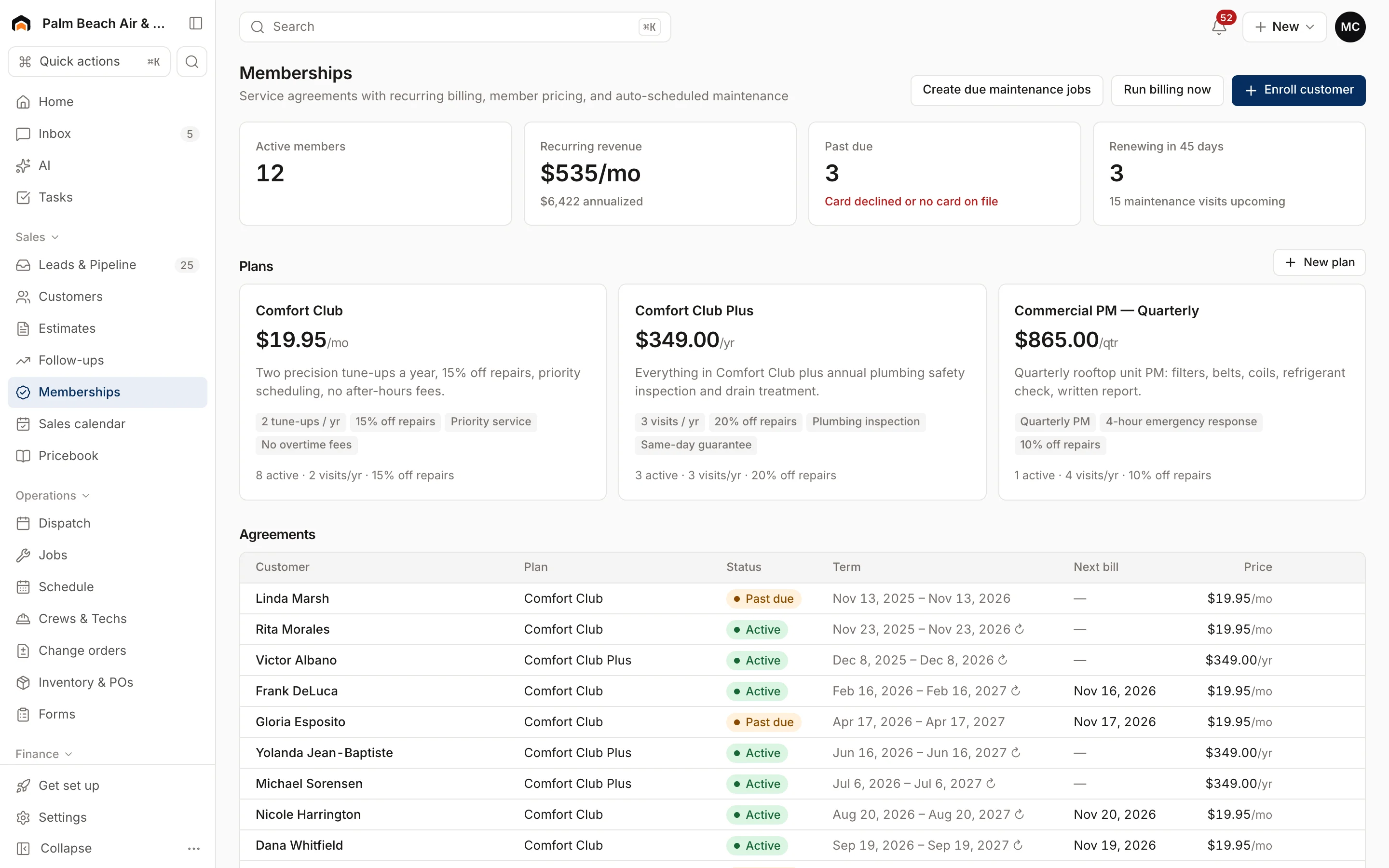
A few details worth knowing:
- Member pricing: the Repair discount % on a plan card is for display. The discount actually applied on estimates and invoices is the company-wide Member discount % in Settings → Pricebook, or an item's own Member price in the pricebook if you've set one. See Give members special pricing.
- Visits: Homeforce spreads the visits evenly across the term and creates an unscheduled maintenance job about 21 days before each one is due. See Schedule included maintenance visits.
- Billing: each period charges the customer's saved card through payments; if there's no card or it's declined, an invoice with a pay link is sent and the agreement shows as past due. See How membership billing works.
- Renewals: active agreements with auto-renew on start a new term automatically; past-due agreements don't. The Renewing in 45 days card shows who's coming up. See Renew or cancel a membership.
FAQ
How much should I charge for an HVAC maintenance plan?
Charge enough to cover the visits, the member discount and payment processing, plus your target margin. Add those annual costs and divide by one minus your margin (and processing rate) to get the yearly price, then divide by 12 for monthly billing. Compare the result with local offers and adjust the plan's contents if needed.
Should a maintenance agreement be billed monthly or annually?
Monthly billing makes the price easier to say yes to and spreads revenue across the year. Annual billing gives you cash up front, and you can offer a small prepay discount for it. If you discount the annual price, check that the margin still works.
How many visits should an HVAC maintenance agreement include?
ENERGY STAR recommends checking cooling in spring and heating in fall, so two visits a year suits a home with both. A cooling-only or heating-only system may only need one. More visits raise your cost, so price each one in.
What repair discount should members get?
Pick a discount you can afford across your whole pricebook, and treat it as a cost in your plan price. If high-ticket parts or equipment can't carry the full discount, set a specific, smaller member price on those items instead.
Sources
- Maintenance Checklist, ENERGY STAR (U.S. EPA and DOE). Accessed 2026-11-03.
- How Often To Flush Your Water Heater (And How To Do It), Rheem Manufacturing Company. Accessed 2026-11-03.