
Pricing
How much to charge for sealcoating (driveways and parking lots)
How much to charge for sealcoating, with per-square-foot pricing, sealer coverage math, crack fill per linear foot, minimums and two worked examples.
The Homeforce team · · 9 min read
Most sealcoating contractors price by the square foot, plus crack filling by the linear foot and a minimum charge for small jobs. Large commercial lots usually land somewhere around a dime to 30 cents a square foot. SealMaster, one of the big sealer manufacturers, puts typical sealcoating at 10 to 30 cents per square foot. Residential driveways cost more per foot because setup, travel and cleanup get spread over far less pavement. Bob Vila's cost guide puts a typical homeowner's total at $275 to $820.
Don't copy someone else's per-foot number, though. Build your price from four things: material at the manufacturer's coverage rate, labor hours, overhead per crew-hour, and a profit margin. Then check it against the market. The rest of this post works through that with real coverage figures and two examples. To run your own numbers, use the sealcoat calculator.
How much should I charge per square foot for sealcoating?
Price per square foot falls as the job gets bigger. Here's why:
- Driveways. You still load the rig, drive out, blow off the surface, edge by hand and clean up, and all of that is spread across maybe 600 to 1,500 square feet. Hand work around garage aprons, walks and landscaping takes longer per foot than open pavement.
- Parking lots. Spray or squeegee rigs cover open pavement quickly, you buy sealer in drums or bulk, and mobilization is a small share of the total. SealMaster lists lot size, number of coats, the type of sealer, repair work and mobilization among the things that move the price.
So don't quote one flat rate for every job. Run the same cost build for each job and let the per-foot number fall where it falls. The two examples below come out around $0.55 per square foot for a driveway and $0.26 for a small lot, using the same labor rate and margin.
How much sealer do you need? Coverage per gallon
Use the manufacturer's technical data sheet (TDS) for the product you actually buy, because coverage varies between products. As an example, here are the figures for one asphalt-emulsion (coal-tar-free) sealer, from the MasterSeal Concentrate technical data sheet:
- Coverage: about 100 to 120 sq ft per gallon of concentrate, per coat, once it's mixed. Once water, additive and sand are mixed in, the mixed material goes down at about 70 to 82 sq ft per gallon.
- Coats: at least two coats, plus an optional third on entrances, exits and drive lanes.
- Mix: per 100 gallons of concentrate, the sheet calls for 15 to 25 gallons of water, ½ to 2 gallons of polymer additive, and 100 to 400 lb of sand.
- Cure: let each coat dry thoroughly before the next, and keep cars off the final coat for 24 hours.
The concentrate figure is the one you price from. For two coats:
Gallons of concentrate = square feet × coats ÷ coverage per gallon
A 1,200 sq ft driveway with two coats at 100 sq ft/gal needs 1,200 × 2 ÷ 100 = 24 gallons. On rough, porous or never-sealed asphalt, use the low end of the coverage range. The data sheet notes that application rates vary with pavement porosity and how the sealer is applied.
How much to charge for crack filling
Price crack filling by the linear foot, as its own line item, and measure every crack. SealMaster's FAQ puts crack filling at roughly $0.35 to $1.00 per linear foot, depending on the footage, how bad the cracking is, how you prep the cracks (air blowing vs. routing), and whether you use hot-pour or cold-pour filler. Consumer guides list higher figures for small residential jobs. Fixr puts crack repair at $1 to $3 per linear foot. That's the same per-foot pattern as sealcoating: small jobs cost more per foot.
The sealer data sheet itself says cracks should be filled before sealing (MasterSeal TDS), so put crack prep in the scope even when the customer only asked about "sealing."
Set a minimum job charge
Many contractors set a minimum fee for small jobs (Bob Vila). To find yours, add up the cost of a short job before any square footage: loading, drive time, setup, cleanup, and the overhead for those hours. Say that comes to 2 crew-hours at $114 per crew-hour (labor plus overhead, as in the example below). That's $228 in cost before you seal anything. At a 25% margin, your minimum would be about $305. Round it to something easy to quote, like $300 or $325.
Worked example 1: a residential driveway
All of the inputs here are illustrative assumptions. Swap in your own supplier prices, wages and overhead.
The job: a 24 × 50 ft driveway (1,200 sq ft), two coats, with 60 linear feet of cracks.
Materials
- Sealer concentrate: 24 gal × $4.00/gal (assumed) = $96
- Sand, additive, oil-spot primer (assumed) = $24
- Crack filler: 60 lf × $0.25/lf material (assumed) = $15
- Materials total: $135
Labor
- 2-person crew × 3.5 hours (including drive, prep, crack fill and two coats) = 7 labor-hours
- 7 × $32/hour loaded labor cost (assumed) = $224
Overhead
- Truck, sealer rig, insurance, office and marketing, assumed at $50 per crew-hour
- 3.5 crew-hours × $50 = $175
Total cost: $135 + $224 + $175 = $534
Price at a 25% margin: $534 ÷ (1 − 0.25) = $712, rounded to $715.
On the estimate, show it as two lines:
- Crack fill, 60 lf × $1.00 = $60
- Sealcoat, two coats, 1,200 sq ft = $655 (about $0.55/sq ft)
That falls inside the $275 to $820 range homeowners see in consumer cost guides.
Worked example 2: a small parking lot
Again, every input here is an illustrative assumption.
The job: 20,000 sq ft, two coats, plus a third coat on 4,000 sq ft of drive lanes and entrances, and 800 lf of hot-pour crack fill. Striping is quoted separately.
Materials
- Concentrate: (20,000 × 2 + 4,000) ÷ 110 sq ft/gal = 400 gal
- 400 gal × $3.50/gal bulk (assumed) = $1,400
- Sand: 300 lb per 100 gal (within the data sheet's 100 to 400 lb) = 1,200 lb × $0.08/lb (assumed) = $96
- Additive: 1 gal per 100 gal = 4 gal × $30 (assumed) = $120
- Hot-pour crack filler: 800 lf × $0.30/lf (assumed) = $240
- Materials total: $1,856
Labor: 3-person crew × 12 hours = 36 labor-hours × $32 = $1,152
Overhead and equipment: 12 crew-hours × $75 (assumed, bigger rig) = $900
Total cost: $1,856 + $1,152 + $900 = $3,908
Price at a 25% margin: $3,908 ÷ 0.75 = $5,211, quoted at $5,210.
That's about $0.26 per square foot all-in, inside SealMaster's 10 to 30 cent range. On the estimate: crack fill 800 lf × $0.75 = $600, sealcoat $4,610.
Driveway or lot, the process is the same. Only the inputs change, and that's what keeps your per-foot price honest. The sealcoat calculator does the gallons and cost build for you.
What temperature and weather do you need to sealcoat?
Sealer has temperature limits, and they belong in your scheduling and your contract. The MasterSeal data sheet requires the surface and air to be at least 50°F and rising during application. It also rules out applying when the temperature is expected to drop below 50°F within 24 hours afterward. Other products set their own limits, so read the sheet for whatever you're putting down.
What that means for pricing:
- Write a weather clause into the estimate. Say that dates move for temperature or rain, and that rescheduling for weather is not a cancellation.
- Plan for rain days and short seasons. Your overhead runs all year, but you can only seal in warm, dry months, so set your overhead per crew-hour from the hours you can actually bill. In a northern market, that pushes your hourly overhead up.
- Sell the off-season. Lining up next spring's work in winter evens out cash flow. See how landscapers handle winter for ideas that carry over.
Coal-tar sealant bans: check before you buy
Coal-tar sealers are banned in some places. Washington State prohibits selling coal tar pavement products since January 1, 2012 and applying them to driveways or parking areas since July 1, 2013. Minnesota banned the use and sale of coal tar-based sealants statewide starting January 1, 2014. Some counties and cities have their own bans.
The reason is pollution. The USGS reports that coal-tar sealcoat contains about 1,000 times more PAHs (polycyclic aromatic hydrocarbons) than asphalt-based sealcoat. Minnesota's stormwater manual says asphalt-based sealcoat performs as well as or better than coal tar at a similar cost. Check your state and city rules, and the product data sheet, since some "asphalt" blends are fortified with coal tar. Then price the product you can legally use.
Doing this in Homeforce
In Homeforce, asphalt and paving companies get a From measurements tab when they create an estimate. You pick a template, enter the measurements, and Homeforce works out the material takeoff and fills in the estimate options from your pricebook. You can still adjust any line, such as the crack fill footage or the third coat.
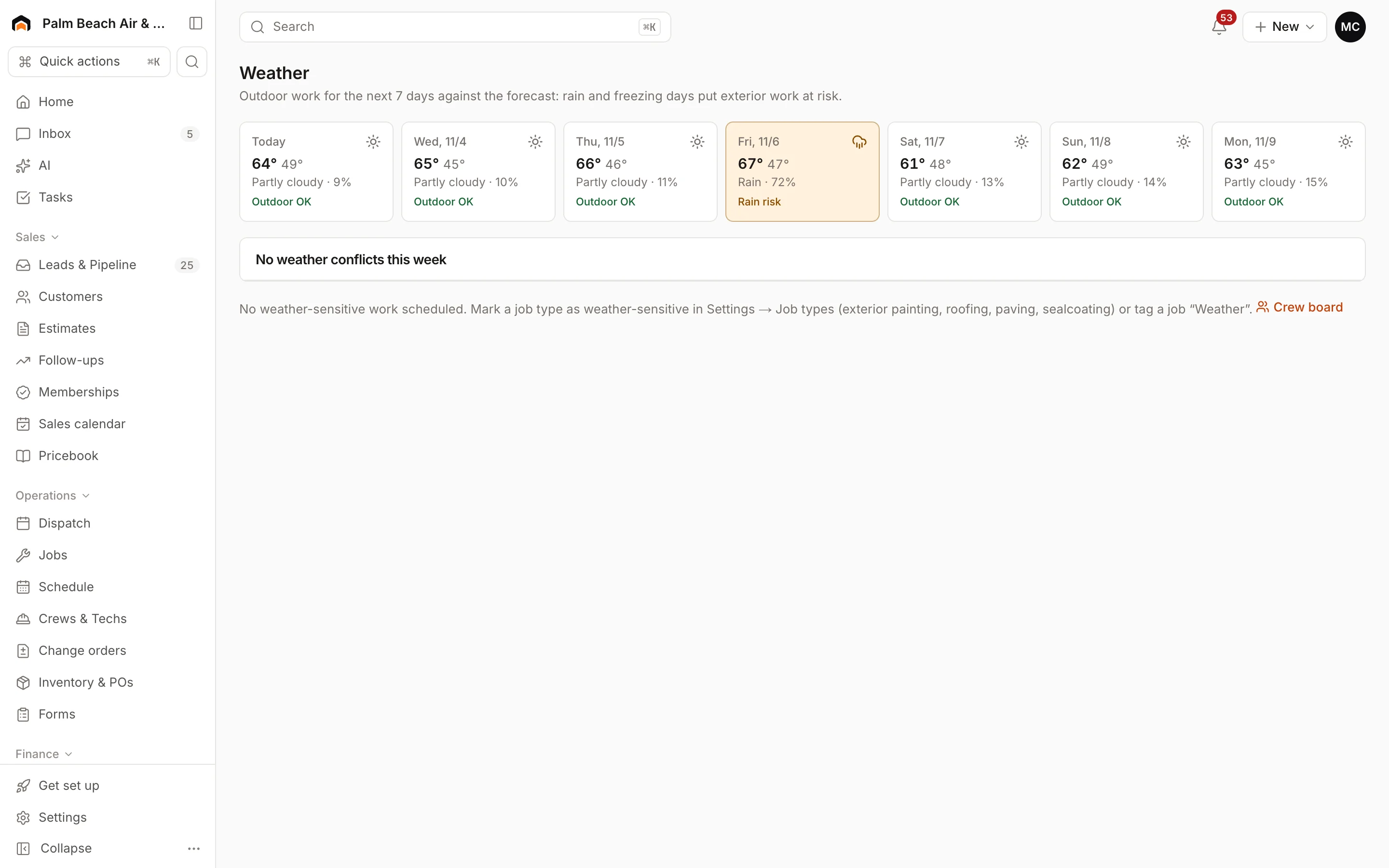
For scheduling, the Weather page checks the next seven days of weather-sensitive visits against each job site's forecast. It flags visits that miss your limits and suggests the next workable day. Nothing moves until you click, and you can text the customer about the new day when you do. You set the sealcoat minimum temperature, the rain cutoff, and whether sealcoat needs a dry next day in Settings → Weather rules. More on dispatch and scheduling.
FAQ
How much should I charge to sealcoat a driveway?
Build it from your own costs: sealer at the data-sheet coverage rate, crew hours, overhead per crew-hour, and your margin. Consumer guides show homeowners typically paying $275 to $820 in total. In our worked example, a 1,200 sq ft driveway with 60 feet of crack fill came to $715.
How much does a parking lot cost per square foot to sealcoat?
SealMaster puts typical sealcoating at 10 to 30 cents per square foot. Big, open lots land at the low end because mobilization and hand work are a small share of the job. Crack filling, a third coat on drive lanes, and striping are usually priced separately.
How many square feet does a gallon of sealcoat cover?
It depends on the product, so check its technical data sheet. As one example, MasterSeal Concentrate covers about 100 to 120 sq ft per gallon of concentrate per coat, and the manufacturer recommends at least two coats. Rough or porous pavement takes more material.
What's the minimum temperature for sealcoating?
Many asphalt-emulsion sealers require 50°F and rising, with no drop below 50°F for 24 hours after application. Some products set different limits, so follow the data sheet for the one you're using. Build the weather limits into your schedule and your contract.
Is coal tar sealer still legal?
Not everywhere. Washington and Minnesota ban coal-tar pavement sealants statewide, and some cities and counties have their own bans. Check your local rules before you buy, and read the product's data sheet to make sure it isn't coal-tar fortified.
Sources
- How much does it cost to sealcoat a parking lot or driveway?, SealMaster. Accessed 2026-11-03.
- How much does asphalt crack filling cost?, SealMaster. Accessed 2026-11-03.
- MasterSeal Concentrate technical data sheet, SealMaster. Accessed 2026-11-03.
- Driveway sealing cost, Bob Vila. Accessed 2026-11-03.
- Asphalt driveway repair cost, Fixr. Accessed 2026-11-03.
- RCW 70A.440.020: Coal tar pavement products, sale or application prohibited, Washington State Legislature. Accessed 2026-11-03.
- Alternatives for coal tar sealants, Minnesota Pollution Control Agency, Minnesota Stormwater Manual. Accessed 2026-11-03.
- Coal-tar-based pavement sealcoat, PAHs, and environmental health, U.S. Geological Survey. Accessed 2026-11-03.