
Hiring
How to hire HVAC technicians (and keep them past the first summer)
How to hire HVAC technicians: where to find them, EPA 608 checks, ride-along interviews, pay plans, a 90-day onboarding plan and what an empty truck costs.
The Homeforce team · · 9 min read
To hire HVAC technicians who stay, follow six steps. Decide which level of tech you actually need. Recruit where techs are trained, not only on job boards. Write a job post that leads with pay and schedule. Check EPA Section 608 certification and any state license. Run a paid ride-along or bench test instead of relying on the interview alone. Then put the new hire through a structured first 90 days. Every week you get one of those steps wrong is a week a truck sits in the yard or a customer gets a callback.
Why is it so hard to hire HVAC technicians?
Most shops are competing for the same small pool of people. According to the U.S. Bureau of Labor Statistics, there were about 440,900 HVAC mechanic and installer jobs in 2025. BLS projects employment to grow 11% from 2025 to 2035, which is much faster than the average for all occupations, with about 40,600 openings a year. Many of those openings come from people retiring or leaving the trade, not from new jobs.
On pay, the same BLS profile puts the median at $61,010 a year, or $29.33 an hour, as of May 2025. That's a national median. Experienced service techs in busy metros earn well above it, and helpers earn below it. Use your local market, not the national figure, when you set a range.
BLS also notes that techs often work evenings, weekends and on-call in peak seasons.
Decide who you're actually hiring
Before you post anything, write down which of these you need:
- Helper or apprentice. Little or no experience. Rides with a senior tech and learns. Cheapest to hire, but costs senior-tech time.
- Service tech. Diagnoses and repairs common failures alone and runs maintenance visits. The hire most shops are short of.
- Senior or lead tech. Hard diagnostics, trains others, often sells replacements.
- Installer. Strong on change-outs and startup, but may not want service calls.
What certifications does an HVAC technician need?
EPA Section 608
Under federal rules, anyone who services equipment in a way that could release refrigerant needs EPA Section 608 technician certification. That includes attaching gauges or adding or removing refrigerant. There are four types:
- Type I: small appliances.
- Type II: high- and very-high-pressure equipment (other than small appliances and motor vehicle AC).
- Type III: low-pressure equipment.
- Universal: all of the above.
The EPA says 608 credentials do not expire. Apprentices are exempt only while a certified technician closely and continually supervises them. For a service tech, ask to see the card (Type II or Universal) and keep a copy in the employee file.
State and local licenses
BLS notes that some states and localities also require HVAC technicians to be licensed. Requirements vary a lot. Check your state licensing board before you write the job post, so you can list the license if it's required.
Background and driving checks
If a screening company pulls a background report for you, the FTC says you must give a stand-alone written disclosure and get written permission first, and send specific notices if you turn someone down because of it.
Where to find HVAC technicians
Go beyond the job boards:
- Trade schools and community colleges. BLS says the typical entry-level education for the trade is a postsecondary nondegree award, so HVAC programs are where your future techs are right now. Call the program director, offer ride-alongs, and ask to speak to a class.
- Registered Apprenticeship. The Department of Labor's Registered Apprenticeship model combines a paid job, structured on-the-job learning with a mentor, related classroom instruction, pay increases as skills grow, and a nationally recognized credential at the end. BLS notes that some HVAC techs train through apprenticeships lasting several years. Start at apprenticeship.gov's employer page to see whether a program already exists near you.
- Referrals from your own techs. Pay a referral bonus in two parts, half at hire and half after 90 days, so people refer techs who stay.
- Supply houses, training nights and adjacent trades like appliance repair and building maintenance.
How to write an HVAC technician job post
Candidates scan for four things: pay, schedule, truck and what calls look like. Put them at the top.
- Title: "Residential HVAC Service Technician," not "Rockstar Tech."
- Pay range and how pay works (hourly, plus any commission or spiff, explained in one line).
- Schedule and on-call: days, hours, how often on-call comes around and what it pays.
- Truck, tools and phone: take-home truck or not, stocked or not, tablet or phone provided.
- The work: service versus install mix, residential versus light commercial, typical calls per day.
- Must-haves: EPA 608 Type II or Universal, driver's license, any state license.
- Training: what you'll teach and who they'll ride with.
Keep the language neutral. The EEOC says job ads may not show a preference based on protected traits such as age or sex. "Recent graduates only" is the kind of phrase it gives as an example to avoid. Describe the job and the skills, not the person.
Interviewing: talk, then test
A good interview has three parts.
Phone screen (15 minutes). Confirm license, 608 type, pay expectations, start date and whether they can do on-call.
Sit-down interview (45 minutes). Ask about real calls: "Walk me through the last no-heat call you couldn't figure out right away." Listen for a logical diagnostic process and how they talk about homeowners.
Ride-along or bench test (half a day, paid). This is where most bad hires get caught. Set up a unit with a fault, like a bad capacitor or miswired thermostat, and watch them diagnose it. Or send them out with your best tech and ask afterward: would you trust this person alone in a customer's house?
How should you pay HVAC technicians?
Three common structures: The numbers below are examples, not market rates. Check local postings and the BLS figures above before you set yours.
- Straight hourly. Simple and predictable. Good for helpers and installers.
- Hourly plus spiffs. A fixed bonus per membership sold or per replacement lead that closes. Rewards the behavior you want without making pay swing.
- Hourly plus commission on sold work, or flat-rate (piece) pay per task. Rewards your best producers, but pay can drop in slow months, and techs may oversell if the plan is set up badly.
Whatever you choose, overtime rules still apply. The Department of Labor says covered employees must get at least 1.5 times their regular rate for hours over 40 in a workweek. For employees paid by piece rate or commission, the regular rate is the week's total pay divided by hours actually worked. Talk to your payroll provider or an employment attorney before you roll out a commission or flat-rate plan.
If you plan to sell memberships, a membership spiff is one of the cleanest incentives you can offer. See how to price HVAC maintenance agreements.
What an empty truck or a bad hire costs
This example is illustrative. Swap in your own numbers.
Say a service truck averages 3 paid calls a day, 5 days a week, with an average ticket of $400. Parts and materials run 25% of revenue. A tech's loaded cost (wages, taxes, insurance, truck) is $45 an hour for 40 hours.
- Weekly revenue: 3 × 5 × $400 = $6,000
- Parts: $6,000 × 25% = $1,500
- Tech cost: $45 × 40 = $1,800
- What the truck contributes toward overhead and profit: $6,000 − $1,500 − $1,800 = $2,700 a week
If that seat stays empty for 8 weeks in peak season, you give up 8 × $2,700 = $21,600. Overhead like rent, office staff and the truck payment still has to be paid. That's assuming the calls go away instead of piling onto your other techs as overtime.
A bad hire isn't free either. Say you pay someone $1,800 a week for 6 weeks before letting them go. That's $10,800, plus callbacks, plus any customers you lose. Paying a good candidate $2 an hour more, which is $4,160 a year at 2,080 hours, often costs less than either outcome.
If you aren't sure what your average ticket or contribution per call is, start with how to price HVAC jobs.
Onboarding: the first 90 days
Most techs decide whether they'll stay in the first few months. A written plan makes the difference.
Days 1-5. Paperwork, truck, tools, phone, software and pricebook. Ride with a senior tech every day.
Weeks 2-4. The new tech leads maintenance visits while the senior tech watches. Review every visit together at the end of the day.
Days 30-60. Solo maintenance and simpler service calls, with a senior tech on call by phone. Weekly one-on-one with the service manager.
Days 60-90. Full service-call load. Review callbacks, average ticket and customer feedback together. At day 90, confirm the hire, adjust pay if you promised a raise, and pay the second half of the referral bonus.
How to keep HVAC technicians
Retention is cheaper than recruiting. What keeps techs around:
- Predictable pay, paid correctly and on time.
- A fair on-call rotation, posted in advance and paid.
- A visible raise path tied to skills, like a new certification.
- A stocked truck, working tools and less paperwork.
- Fewer wasted trips. Customers who aren't home burn a tech's day. See how to reduce no-shows.
Doing this in Homeforce
Homeforce won't recruit for you, but it makes the job easier for the techs you hire. The mobile app puts the whole visit on one screen. Techs tap On my way, I've arrived and Complete visit, and fill in checklists, photos and signatures. It all works with no signal. Driving and on-site time are logged as they go, which feeds timesheets and payroll.
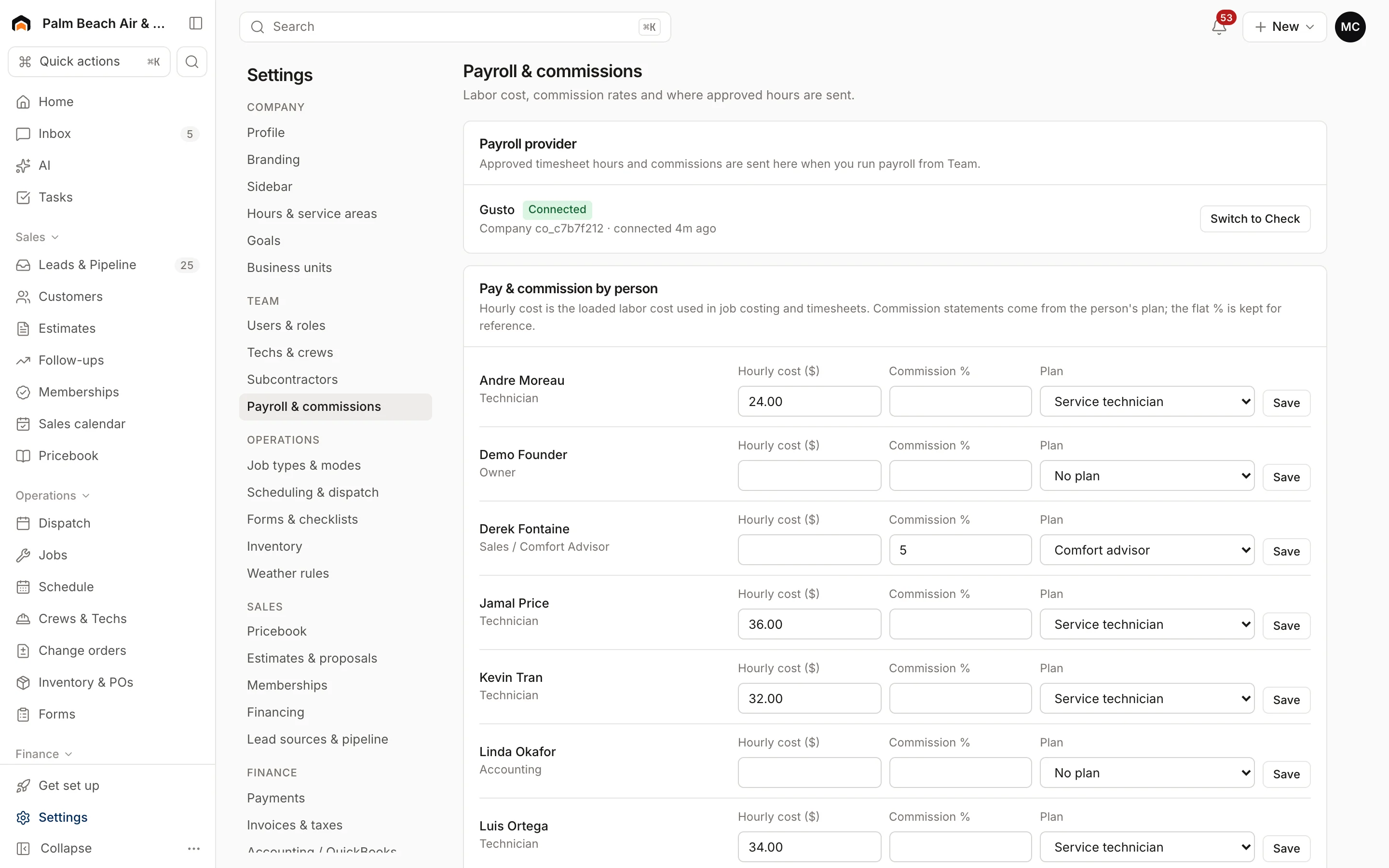
In Payroll & commissions, you set each person's hourly cost and put them on a commission plan. A plan can pay a percentage of sold estimates, a percentage of paid job revenue, or a flat amount per membership sold. Techs never see each other's pay.
During onboarding, the Technician & sales performance table on Reports shows each person's visits, hours on site, job revenue, average ticket and close rate. That gives your day-60 and day-90 reviews real numbers to talk about.
FAQ
How much does it cost to hire an HVAC technician?
Hiring costs vary with how you recruit: job ads, referral bonuses, the paid ride-along, background checks, plus the senior tech's time spent training. The bigger cost is usually the revenue lost while the truck sits empty. Use the worked example above with your own average ticket and calls per day to see what each week of vacancy costs you.
Do HVAC technicians need to be EPA certified?
Yes, in most cases. The EPA requires Section 608 certification for anyone who services equipment in a way that could release refrigerant. Apprentices are exempt only while a certified tech closely and continually supervises them. Some states and cities also require a separate HVAC license.
Should I hire experienced techs or train apprentices?
Most shops need both. Experienced service techs fill an empty truck fastest. Apprentices are how you stop competing for the same few experienced people every year. A Registered Apprenticeship program gives you a structure for the training side.
Is flat-rate or commission pay better for HVAC techs?
Neither is better for every shop. Commission and flat-rate pay reward top producers but can make pay swing and tempt overselling. Hourly plus small spiffs is easier to manage. Whatever you choose, nonexempt techs still need overtime at 1.5 times their regular rate for hours over 40 in a workweek.
Sources
- Heating, Air Conditioning, and Refrigeration Mechanics and Installers, Occupational Outlook Handbook, U.S. Bureau of Labor Statistics. Accessed 2026-11-03.
- Section 608 Technician Certification Requirements, U.S. Environmental Protection Agency. Accessed 2026-11-03.
- Registered Apprenticeship Program, U.S. Department of Labor. Accessed 2026-11-03.
- Employers, U.S. Department of Labor, Apprenticeship.gov. Accessed 2026-11-03.
- Background Checks: What Employers Need to Know, Federal Trade Commission. Accessed 2026-11-03.
- Prohibited Employment Policies/Practices, U.S. Equal Employment Opportunity Commission. Accessed 2026-11-03.
- Fact Sheet #23: Overtime Pay Requirements of the FLSA, U.S. Department of Labor, Wage and Hour Division. Accessed 2026-11-03.